6096 comments
2357 subscribers
6254 on Twitter
Subscribe! Feed reader E-mail

On this page:

Experience report: Designing my logo

Update 2012-12-31: Made the swoosh swooshier!

Having come up with a name for my business (I turn experiences into visuals, so ExperiVis!), I decided to spend some time figuring out what a logo might look like. I need this in order to start creating sketchnote templates and choosing colour schemes for marketing materials. Here’s what I sketched:

image

I tried a plain lettering style versus typing it in, and I preferred the formality of typing things in. Replacing the X with a stylus made me smile, so I kept it. I liked red more than blue – I think it’s more exciting, even though red might also make people think of grade school teachers, incorrect answers, and negative results.

W- thought bright red was more vivid and energetic than the dark red I’ve been using for my website, so I used bright red. He also suggested adding the little eraser cap like the way the Lenovo stylus is designed:

Here’s the image after I cleaned it up in Inkscape:

experivis

Update 2012-12-31: Now with a swooshier swoosh!

experivis

I think it’s a good starting point. =) Next steps: Sketch my services!

Short URL: http://sachachua.com/blog/p/24291

Imagining sketchnotes as a business

People tell me that conference/presentation sketchnotes are an amazing service. I’ve been getting paid to cover conferences and events, so I’m thinking of focusing on building this as a business in 2013. Here are some ideas I’ve been playing around with:

20121210 business planning - imagining wild success for sketchnotes

THE PAIN

Imagine you’re a conference or event organizer. You want to make sure your attendees get a lot of value out of your conference, and that a lot of potential attendees hear about it so that they’ll sign up for the next one. That’s why you’re using social media, you share slides, you’re working on getting videos uploaded, and so on. BUT you’re still only engaging a small fraction of your potential audience because most people don’t have the time to review all the materials, people aren’t interested in wading through lots of slides or text, or the materials are published long after people have gotten distracted by something else they need to focus on.

Sketchnotes can help you help your participants remember and share key points from the conference, increasing their ROI (and yours!). By sharing these images, people become ambassadors for your conference.

THE BENEFITS

This is about helping organizers engage participants through digital sketchnotes that are published throughout the event, taking advantage of the Twitter buzz. Sketchnotes can offer more information and more context than live-tweeted quotes, and they can reinforce the conference brand and sponsor relationships through templates. included in every sketchnote.

After the event, these notes also help participants remember and share key points from the conference. People can feel overwhelmed by all the great ideas they’ve picked up from a conference. When they get back to their offices, they probably need to justify their participation in the conference by writing a report on what they’ve learned. Few people have the time to review slides or re-watch videos. Conference sketchnotes are a quick way to trigger memory, and they can also be shared with people who have not been to the talks. This additional value gives conference organizers a good reason to follow up with participants after the event, which could influence feedback survey completion rates and scores.

Sketchnotes can also help organizers pre-market the next event. As a quick proof of the content covered in the conference, sketchnotes can spark interest in a way that slides may not. Often tweeted, reblogged, and searched for after an event, they’re an excellent way to share great ideas.

ALTERNATIVES AND DIFFERENTIATION

One of the great things about this is that I don’t have to build a market from scratch. Bloggers and live-tweeters are now part of many conferences’ social media and marketing planning, so there’s an established need for real-time sharing. Video/slidesharing is part of many conferences as well. Many companies and conferences have worked with graphic recorders and facilitators to capture and share discussions.

Organizers use several alternatives for engaging people during and after events, some of which are complementary services. Here are a few:

  • Doing nothing: No cost. However, this misses out on the opportunity for engagement.
  • Live-tweeting: Often on a volunteer basis, although sometimes there’ll be a small team dedicated to monitoring, responding to, and posting on social media networks. Live tweets are good for engagement, but are difficult to curate or read afterwards.
  • Live-blogging: Often on a volunteer basis, or in exchange for admission. Variable quality and shareability. Sometimes results in lots of text that people don’t enjoy reviewing afterwards.
  • Posting the slides: Many conferences post slides on Slideshare, Lanyrd, or similar sites. This tends to be a split between presentations that have too much text in them and take much time to review, or presentations that have practically no text in them and are impossible to share with people who have never been to the conference.
  • Posting the videos: This can take months, if it gets completed at all. It takes time to review these and find the key points.
  • Transcripts: Very few conferences post transcripts of talks. It’s expensive and time-consuming, although transcripts can increase the searchability of a talk.
  • Graphic recording / facilitation: Excellent for discussions. Visually impressive, as artists work on huge sheets of paper at the front of the room. Can be distracting if people are tempted to watch the graphic recording instead of watching the speaker. Takes time to post-process the images for posting, so not well-suited to publishing during the event itself. Less flexible when it comes to content because it’s hard to erase or move segments of a drawing. Matching colours, adding logos and sponsor information, and using other template elements may not be cost-effective.

I think there is a space right there, in the gap between

  • social media blog posts / tweets / slides / video on one hand (a “good” conference these days), and
  • full graphic recording / facilitation

where digital sketchnoting makes sense, especially considering the advantages to working with an all-digital workflow. (Quick publishing, templates, non-distracting setup…)

Also encouraging: I’m not the only one looking into this! Here are some companies offering digital sketchnoting/digital scribing services: The Grove Consultants International, Imagethink, See in Colors, The World Cafe, WrightMarks, LearningTimes, Virtual Visuals

Potential differentiators:

  • I have a technical background, which means I’m fine with acronyms, diagrams, and lots of abstract/obscure concepts (especially related to web design/development, social media, social business, mobile development, and other topics I’m personally interested in)
  • Many visual communication companies focus on large-scale graphic recording; by specializing in digital sketchnoting, I can get really, really good at it
  • Many sketchnoters / visual communicators are coming from paper-and-pen backgrounds or Mac backgrounds; I use a different toolset, and I continually experiment with making it better
  • I’m comfortable with social media, and have set up many tools to help me make even better use of it
  • I can offer complementary services, such as getting a talk transcribed and turned into an e-book
  • I speak, too! People enjoy my practical, down-to-earth illustrated talks, and hundreds of thousands of people have viewed my presentations online.

SALES AND MARKETING

Most conference and event organizers won’t be looking for sketchnoting in particular, so I’ll want to start by identifying potential clients, reaching out to people, and figuring out the possibilities together.

Another way to find potential clients would be to work with event producers who help organize lots of events. Sketchnoting becomes another capability they can offer to clients in order to add value.

People might not know how to make the most of sketchnotes as a resource. By handling the social media publishing and coordinating with the event’s social media team, I can simplify the process. I’ll also put together a guide for organizers who have existing blogs, Twitter accounts, Pinterest accounts, and other publishing platforms, so that they can take advantage of the sketchnotes that they’ll have.

My long-term evil plan

One of the reasons I’m interested in building a business around sketchnoting is because I want to learn more about sales and marketing. I could learn these business skills using web development or consulting instead, but those engagements involve longer iterations and less tangible services. Sketchnotes are easy to appreciate and share.

In addition, sketchnoting business and technology events also helps me build my visual communication skills, my understanding of topics, and my archive of content. This will come in handy when I write more books and work on more experiments. I think there’s room in the world for more visual books like the Sketchnote Handbook, especially as we shift towards reading less and wanting to understand things faster.

I think that sketchnoting might turn into an interesting 12-16 hour/week business that takes advantage of and fits in well with complementary strengths. Looking forward to trying this out!

More notes: Business idea: Digital sketchnoting agency

Short URL: http://sachachua.com/blog/p/24222

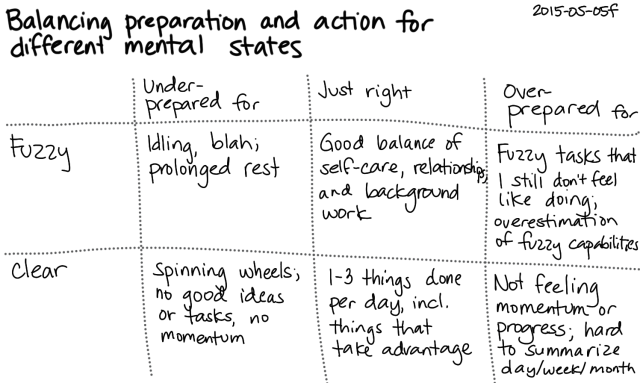
One to three, that’s all

One to three good pieces of work each day. That’s all I want to check off my list, and anything else is a bonus. On a day-by-day basis, this seems unambitious. Sometimes I wonder if I’m wasting this opportunity of an experiment – but I’m slowly feeling my way around, and it’s good to take my time.

This week’s accomplishments:

  • Monday: business planning, and a meeting with a potential client.
  • Tuesday: book sketchnotes, the book club, and halfway through putting together an e-book follow-up for my talk
  • Wednesday: lunch with another entrepreneur; coffee with Quantified Self organizers and brainstorming; ENT101 sketchnote; finishing the e-book
  • Thursday: digital sketchnoting podcast with Mike Rohde; on a personal note, survived another fitness class
  • Friday: first coworking session at ING Direct; more business planning; brainstormed business marketing with someone

I am so glad I stumbled across the power of writing and review. It’s much too easy to forget about where the time has gone, and to forget to celebrate the small wins.

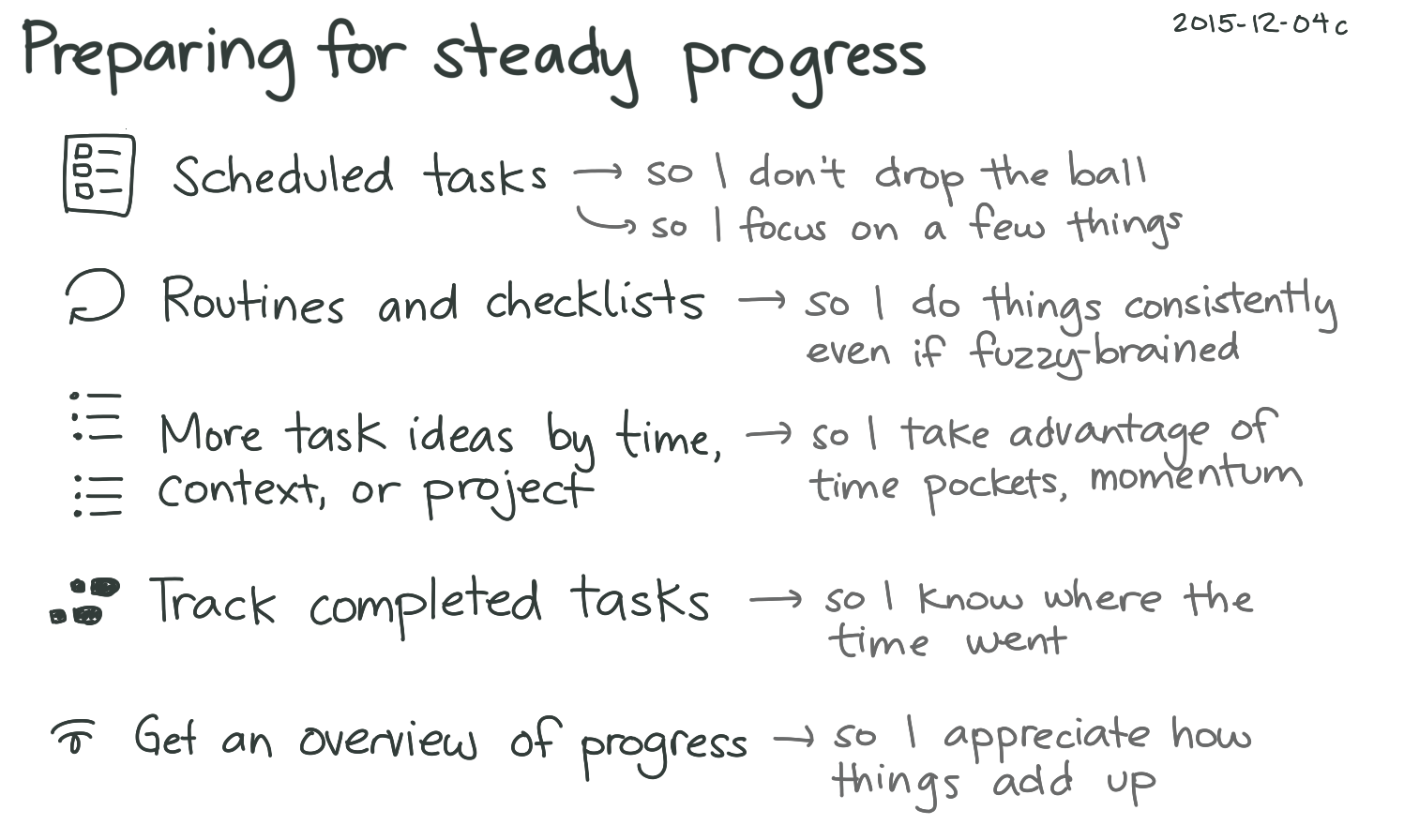
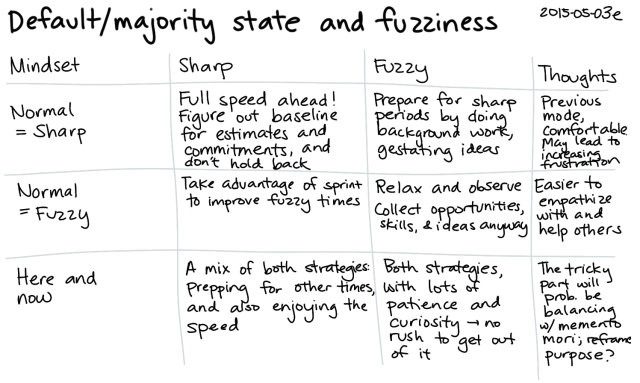
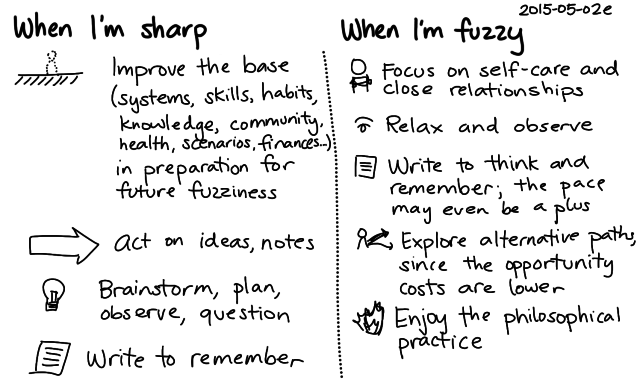
While I waited for W- to finish his krav maga class, I mapped different emotions and the situations in which I feel them. The predominant emotion for this week has been a little hard to pin down. It’s not quite the thrill of developing code and closing tickets, or the happiness of having everything line up. It’s more amorphous. I think it’s more of a patient, deliberate preparation.

One thing at a time, one step in front of the other. If I accept this as the normal, it’ll probably be much better for me than assuming that normal is a whirlwind of activity.

Then I can hack this pace, bit by bit. I can experiment with breakfasts and other starts. I can write down more challenges and worries, and I can get better at working with other people to make things happen. I can figure out what my “treats” are – those small, productive tasks that give me a thrill – and sprinkle them through my week.

I’ve played with the “manic productivity” setting in life. Let’s see if I can get the hang of “steadily increasing strength.”

Short URL: http://sachachua.com/blog/p/24168

Investing time into building sketchnotes as a business

Something shifted, and I was curious about what it was. I’ve been drawing a whole lot more than I did last year and the year before that. How much more?

image

(Data extracted from my Evernote notebook using XSLT and Microsoft Excel)

That much more. Over the past 50 sketchnotes in my Evernote notebook, I’ve averaged a sketchnote every 1.2 days. There are 119 sketchnotes there now, all searchable, and it’s fun to trace the developments in my skills and style. (For example, I’ve recently discovered colour!)

I think the inflection point was getting feedback from people that this was really useful for them. When I go to events and mention that I do these sketchnotes, people light up in recognition and tell me the notes are awesome. Some ask me if I cover corporate events and conferences as well, and I’ve been setting up lunches and coffees to discuss the possibilities. On Monday and Wednesday, I have some paid gigs coming up – sketchnoting a conference, then sketchnoting to support business communication.

As part of this 5-year experiment, I think it might be worth seeing what kind of business I can turn sketchnoting into. It’s so different from the consulting and web development that I did at IBM. I can see how it creates value for and delights people, so why not?

So, what do I need to do in order to explore this?

  • Get the hang of talking to potential clients and understanding their needs. I want to deeply understand that spark of curiosity and desire that prompts people to ask me if I can do this for their organization. I want to know the kinds of words that resonate with people, and use that when talking to them and to others.
  • Simplify the experiment so that I can learn about it in chunks. For example, I was uncertain about pricing because I was curious about what this would look like with value pricing, which means I need to get a better handle on the value it creates. I think it will be easier if I simply pick a rate (say, $75/hour) and go with time-and-materials pricing.
  • Open for business! Invest in business development, get engagements, and make stuff happen. Some “trophies to unlock”: get three clients; get a recurring relationship; get a completely remote client.
  • I can keep improving my website so that people can find out about my services online. I’ll start with this page, which I can link to from all the sketchnotes. I’d like to add more of a handwritten feel to my website and start putting together tips specifically for helping people with visual communication and engagement, maybe even splitting off a separate blog for easier navigation.

Other considerations:

This is still a service business like consulting and web development are. While less lucrative, it does offer the following advantages:

  • I can learn more about marketing and sales because the service is more visual and easy to communicate
  • It uses smaller, more flexible chunks (two hours here, four hours there, a day scheduled well in advance) instead of the more solid chunks of focus I need for development
  • It’s less stressful – I don’t have to worry about bugs or systems going down, just typos
  • It lets me experiment with building a radically different business
  • I can use the skills and knowledge gained to build products that are relevant to more people

I’m taking December off from consulting and focusing on building this as a business. By the end of December, I want to have the beginnings of a clear value proposition stated in customer language, testimonials based on paid engagements, and a marketing plan for identifying and going after companies I might want to work with. I also want to have an idea of what wild success might look like, so that I can get a sense of whether the end game appeals to me. We’ll see how it goes!

As another part of this experiment, I’m going to see what happens if I share as much as possible during the adventure. I’ve shared the kinds of services I’m thinking about offering, key competitors (including links!), my motivations, how to test this idea, even my pricing thoughts. The past ten years of blogging have shown me that sharing often leads to amazing conversations and even more things learned, so let’s see what happens if we do that in business, too.

I’m going to be learning a lot – and I can probably learn and share even more with your help. I’d love to talk to people who have hired or contracted with illustrators, social media people, and event promoters to find out what those buying decisions looked like. I want to learn about managing deal flow from freelancers who work on small gigs. What else can I learn from you and share with everyone else? What kind of help should I be asking you for?

Short URL: http://sachachua.com/blog/p/24089

Business update: Tax update

I filed my taxes on November 2 by myself, since I wasn’t comfortable with the first accountant I hired. It turned out to be not that scary (aside from, well, making really big electronic payments) – I don’t mind balancing books, making sense of GIFI codes, or searching the Quickbooks/TurboTax websites for information.

A little over two weeks later, I received a Corporation Notice of Assessment that said I owed an additional $146, with no interest due if I paid it before December 31, 2012. (Good news: that means my tax payments made it into the correct account!) The difference was in the Ontario tax calculations. It was easy to send in another tax payment through my bank.

Someone from the Canada Revenue Agency has been trying to reach me in order to ask questions about my HST registration. We’ve been playing phone tag for a few days. I called the CRA to follow up on that and ask a couple of questions. I confirmed that I was eligible for quarterly instalments instead of monthly instalments. The CRA agent also pointed out that I needed to take into account that I just wrapped up a short tax year, so I recalculated all of my instalments and set up bigger payments. I double-checked that they don’t mind me overpaying my instalments for a little peace of mind. (I know, funny question! “Is it okay if I send you more money than I need to?”) Whew!

I’d still like to know an accountant whom I can e-mail quick questions or ask to review my books. In a few years, I’ll probably want to start taking money out of the corporation in order to take advantage of the basic personal exemption for taxes, and it would be great to have an accountant help me get that set up properly. In the meantime, it’s good to know that the CRA isn’t all that scary – no be-suited auditors breaking down our door! <laugh>

Short URL: http://sachachua.com/blog/p/24083

Validating ideas and working with other people

Here are the next chunks in my personal business curriculum: validating business ideas, and working with other people in order to make things happen. I might be able to learn both at the same time. In fact, that’s probably the only way I can learn either. If I validate business ideas but take on all the work myself, then I’m limited by my time and what I can do. If I work with people without checking that the end goal is something that’s valued by others, then that would be a very short experiment indeed.

I talk a lot about the intersection of what people value, what you’re good at, and what you enjoy doing. Reviewing my archives, it boggles that the core of the diagram I drew in 2009 is still true. Going deeper into my passions leads me to things that people value more. I’m building the foundation of my 5-year experiment on things I’ve loved doing for a while, and that’s working out decently. I could spend five years validating ideas and building businesses within that intersection. It wouldn’t need as much work. People have blazed those paths before. Proven business needs in proven business models.

But the hardest part of drawing is to see familiar things in an unfamiliar way. One way to break yourself out of drawing what you think you see is to draw the negative space – to focus on the gaps. If I look at business and life and focus on—what is it? the gaps? the missed opportunities?—and not just the hammer-looking-for-nail gaps I instinctively see because of my own skills and experiences (oh, yes, there, that just needs a web app, an Emacs Lisp script), but gaps whether or not I know how to solve them myself—who knows where that can take us?

If I want radical growth instead of just incremental growth, I’ll need to be able to work with lots of other people’s Venn diagrams, orchestrating the intersections in order to make things happen, and helping people get closer to their own sweet spots.

This path is rougher and more uncertain, but I’ll learn a lot in the process. I want to get better at scenting value and scale, getting a sense of where the opportunities are. I want to figure out what things really cost in terms of time and energy. If I do that, then I can go after the things that turn out to cost (me? someone? a loosely-knit team?) much less than the value they create.

Reinforcement is good. For some things, I can reward and attune that sense by earning some of that value back (another fun experiment). For other things, I can get the value back in intangible ways. So I’ve been working on making more things happen: nifty ideas and trial balloons. The more ideas I can move through this experiment of creating value, the more I can learn from the successes and failures. It’s easier to start with something that’s already a good idea. Besides, it’ll work out wonderfully; it always does.

I’m still learning how to draw with different colours. Now I’m learning how to do that with life, too. Whom should I learn from? Who does this amazingly well?

Short URL: http://sachachua.com/blog/p/24008

Buying time: Experimenting with scheduling

One of my business validation experiments has suddenly kicked into high gear. People love the sketchnotes I’ve been taking. Since they’re interested in illustration and event coverage, I’m happy to take advantage of that opportunity to learn more about business. I want to see where we can take this. In addition, I want to connect with way more people and find out how I can help them.

I’ve been investing more time into delegation as a way to buy time and share opportunities. One of the small processes I’d like to delegate is scheduling, which can be quite stressful for me. I often review my mail on the subway, and it’s difficult for me to look up locations or refer to notes. I worry about time zones and missed connections, so I want to make sure that there are calendar entries at the right time, with the right people, and with backup contact information. As I dig deeper into validating business ideas and connecting with people, I’ll be trying to set up appointments with so many people that I’d worry about dropping the ball, not getting back to people, or not following up in case people haven’t gotten back to me.

Software tools such as ScheduleOnce aren’t quite there yet in terms of completely handling the scheduling process. I want to be able to delegate appointment-setting to someone who can arrange times, suggest venues, make sure important information is included in the event description, and follow up as needed.

One of my friends was open to the idea of working as my virtual assistant, so I set her up on oDesk and gave her access to my accounts. It’s good to know people you can trust with your Google account. While you can delegate without giving full mail and calendar access, some things are just easier when people can find what they need. I did set up a separate email account for her so that she wouldn’t have to clutter her personal mail with all the requests.

Even though we’re just starting out, it’s such a relief to be able to forward her mail and know that she’s going to keep track of things. We’re not quite at a smoothly running process yet, but maybe we’ll get there in the next few weeks. I’d love to get to the point where I have a few keyboard shortcuts for templates that explain what’s going to happen (including details she’ll need in order to plan), and she’ll follow up and make it happen. I’d also like to be able to keep track of the people that we’re trying to reach and where we are in the process. She’s been busy catching up with other work this week, but I hope that as her coursework settles down and we work out the kinks in the process, things will run even more smoothly.

I’m also experimenting with automated ways to make it easier to arrange times. ScheduleOnce seems to be the most promising of the bunch. Doodle often gets timezones quietly wrong, and Tungle is just about to close its doors. I’m not completely sold on ScheduleOnce, but people seem to have the fewest problems scheduling with it. There’s so much more to setting appointments, though.

If we’ve got a lunch, coffee, or call coming up in the next month or so, I appreciate your patience as we experiment with the scheduling process!

Short URL: http://sachachua.com/blog/p/24002

Get the highlights as a PDF!

Stories from my Twenties: Highlights from a Decade of Blogging

Free sample!