6199 comments
2357 subscribers
Follow me on Twitter (@sachac)
Subscribe! Feed reader E-mail

On this page:

Buying time: Experimenting with scheduling

One of my business validation experiments has suddenly kicked into high gear. People love the sketchnotes I’ve been taking. Since they’re interested in illustration and event coverage, I’m happy to take advantage of that opportunity to learn more about business. I want to see where we can take this. In addition, I want to connect with way more people and find out how I can help them.

I’ve been investing more time into delegation as a way to buy time and share opportunities. One of the small processes I’d like to delegate is scheduling, which can be quite stressful for me. I often review my mail on the subway, and it’s difficult for me to look up locations or refer to notes. I worry about time zones and missed connections, so I want to make sure that there are calendar entries at the right time, with the right people, and with backup contact information. As I dig deeper into validating business ideas and connecting with people, I’ll be trying to set up appointments with so many people that I’d worry about dropping the ball, not getting back to people, or not following up in case people haven’t gotten back to me.

Software tools such as ScheduleOnce aren’t quite there yet in terms of completely handling the scheduling process. I want to be able to delegate appointment-setting to someone who can arrange times, suggest venues, make sure important information is included in the event description, and follow up as needed.

One of my friends was open to the idea of working as my virtual assistant, so I set her up on oDesk and gave her access to my accounts. It’s good to know people you can trust with your Google account. While you can delegate without giving full mail and calendar access, some things are just easier when people can find what they need. I did set up a separate email account for her so that she wouldn’t have to clutter her personal mail with all the requests.

Even though we’re just starting out, it’s such a relief to be able to forward her mail and know that she’s going to keep track of things. We’re not quite at a smoothly running process yet, but maybe we’ll get there in the next few weeks. I’d love to get to the point where I have a few keyboard shortcuts for templates that explain what’s going to happen (including details she’ll need in order to plan), and she’ll follow up and make it happen. I’d also like to be able to keep track of the people that we’re trying to reach and where we are in the process. She’s been busy catching up with other work this week, but I hope that as her coursework settles down and we work out the kinks in the process, things will run even more smoothly.

I’m also experimenting with automated ways to make it easier to arrange times. ScheduleOnce seems to be the most promising of the bunch. Doodle often gets timezones quietly wrong, and Tungle is just about to close its doors. I’m not completely sold on ScheduleOnce, but people seem to have the fewest problems scheduling with it. There’s so much more to setting appointments, though.

If we’ve got a lunch, coffee, or call coming up in the next month or so, I appreciate your patience as we experiment with the scheduling process!

Short URL: http://sachachua.com/blog/p/24002

Thinking about wild success

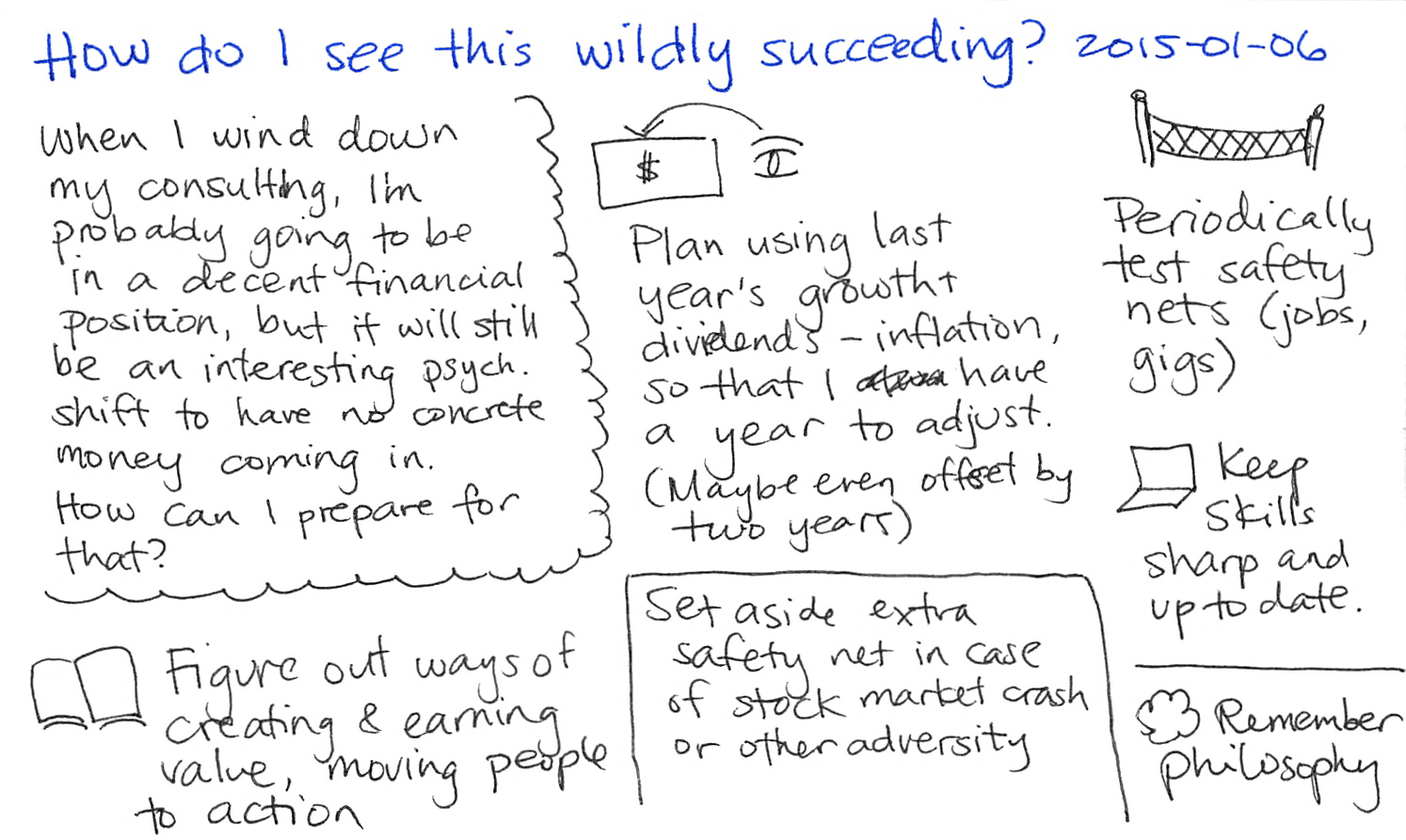
The more I explain this 5-year experiment to others, the more I understand it myself. =) I thought I’d spend some time thinking about what I wanted out of experiment and what wild success looks like, so that more people might be able to help me along the way.

I think the period of five years because it usually takes about that long before a business can be solidly established. Shorter, and I might mistake the fluctuations of figuring things out for long-term difficulties. Longer than that, and I might drift aimlessly without self-imposed goals or deadlines. Telling myself that I’ll take a close look at where I am and reevaluate my decisions in five years means that I can plan and budget for a fixed time period. Controlled uncertainty.

So where do I want to be on February 19, 2017, the 5th anniversary of starting my own business? What do I want to be able to say? What do I want to have done? Let me fast-forward to my future 34-year-old self and think about what that blog post might look like.

Here we are, five years after I started. I’ve learned a ton in the last five years. It turned out that making things happen isn’t anywhere nearly as scary as I thought it might be. I’m looking forward to bringing even more awesome ideas to life.

I’ve been so lucky to start with something that people immediately wanted and needed. Through consulting, I was able to help people take their businesses to the next level. I worked with amazing people who not only helped me take advantage of my skills and experiences, but also helped me develop new skills. We successfully transitioned all of my responsibilities, and they’ve turned that work into wild successes of their own.

Consulting allowed me to self-fund further experiments. I shared opportunities with other people, working with virtual assistants and other team members in order to get even more out of each day. In the course of training them to take over many of my processes, we built an operations manual that makes it even easier to bring new people on board. Many entrepreneurs’ growth is limited by their ability to trust and delegate, and by the network of people they have. Although I’ve also had my share of rough relationships, I’ve had the pleasure of building an amazing team with skills and passions that complement my own, and I reached out to an even wider network of people I can help and who can help me. Many of the people I’ve worked with have grown their own businesses into something they love doing.

Although I was tempted to continue consulting because it was familiar and comfortable, I eventually pushed myself to try other business models. I learned how to validate business ideas by talking to people and prototyping concepts, instead of simply building something and hoping people will come. It was also tempting to continue with the first new business as a job, but I pushed myself to grow out of it, bringing other people in so that they could make the most of those opportunities when I learned even more about creating businesses.

I learned so much along the way, and I’m glad I’ve been able to put them together in different books – at least one for every year of my experiment. I’ve shared what I learned about networking, productivity, delegation and automation, visual communication, entrepreneurship, business, and making things happen. Taking notes along the way really helped, and so did pushing myself to have interesting and novel experiences. I’m glad that so many people have found the books useful, and I’m sure my parents get a kick out of seeing me in print.

I’m now much more comfortable with reaching out to people and inviting them for lunch or coffee. I always learn lots of things in the conversations, and following up has become its own pleasure. I even host events so that I can bring people together.

In terms of paperwork, my attention to detail and comfort with numbers really paid off. The accountant helped me keep all of my books in order, and the CRA auditor found it easy to verify my records.

In my personal life, I continue to be the luckiest person in the world. W- is fantastic, and home life has somehow managed to keep getting better and better. We’ve got a solid financial foundation, and are excited about the possibilities.

What do the next five years hold for us? I’m not sure yet, but I’m sure it will be a good adventure.

My future 34-year-old self on Feb 19, 2017

We’ll see how it goes!

Short URL: http://sachachua.com/blog/p/23906

Business adventures: Accounting

One of the tough but crucial lessons in growing a business is learning when to part ways. I ended one of my oDesk arrangements with an accountant/bookkeeper when I realized I just wasn’t comfortable working with her. I’d had mixed feelings for a while, so I spent some time sitting down, reviewing her work, and trying to clarify things so that I could get the partnership back on the right track.

When I paid attention to how I felt and what I was worried about, I realized that I’d lost confidence in her and our working relationship, so it was better to make the transition. Fortunately, our digital workflow made it easy. I revoked her access to my shared Dropbox folder, ended the oDesk contract, unshared the password I’d given her through LastPass, and cancelled the authorization on file with the Canada Revenue Agency. It was much less awkward than arranging for the physical transfer of receipts might have been.

I don’t think I’ve learned enough from this to ace future hiring decisions. I’m glad that I set it up as a small, low-risk experiment, working with her for a few months instead of scrambling to find an accountant near my filing deadline. In the future, I might get better at figuring out people’s strengths and avoiding their weaknesses, and paying more attention to niggling doubts.

In the meantime, I want to make sure that I meet all the relevant tax deadlines, so I’ve been crunching the taxes myself. TurboTax turns out to be not that scary to use. I had to figure out the GIFI codes for tax-line mapping and I’m not entirely sure about some of them, but once I got that sorted out, TurboTax imported my Quickbooks transactions.

It’s a good thing I kept my first year of business fiscally simple: no dividends, no salary, no home-office deductions, no creative tax arrangements. I’m probably going to be paying more corporate income tax than I should and I’ll likely be audited at some point, but I think it all works out in the end. Next steps: get my web access code, confirm when I need to file taxes, and see about getting another accountant who can review my books.

Onward and upward (and maybe sideways)!

Short URL: http://sachachua.com/blog/p/23931

Business card kaizen

I’m nearly out of business cards, so it’s time to think about how I want to redesign them. Business cards are nowhere near the heart of a business (sales! service!), but I like paying attention to the little things that can help me connect better with other people.

What do I use my business cards for? What do I want my business cards to do? Business cards are ostensibly so that people can get in touch with you. Many people tell me they’re terrible at following up with people after events. The only ones who seem to do so are the ones who collect business cards so that they can add you to their mailing list! I find it helpful to completely ignore the original purpose of business cards and take the initiative of following up with people myself. This works out much better than trusting that people will e-mail me or call me afterwards.

If I’m not giving people business cards in order for them to follow up with me, what benefit do I get from carrying around and giving out these little pieces of paper?

People usually exchange business cards in the middle or towards the end of a conversation. My business cards are good at adding an extra "bump" to the conversation – an additional spark of interest. People often remark on my picture and the keywords I use ("Tell me more about what an Enterprise 2.0 consultant does…" "Oh, what have you written?" "Ooh, storyteller. What’s with that?" "Oh, look, geek! Me too!"). Here’s where those conversations go:

  • Picture: This helps me communicate that I care about helping people remember. I usually commiserate about the post-conference blur of going through a stack of business cards and not remembering who’s who. Some people recognize me better from the picture, because it’s the same avatar I use on Twitter, Facebook, and LinkedIn. I sometimes point out that one of the reasons I cropped that picture so tightly is that the picture will always be current even if I change hairstyles, which makes people laugh — and communicates that I think about little details like that. Because most people see photos only on business cards for real estate agents, I also joke about that. (Hmm, maybe I should play with that some more – a real estate agent, but for the brain!)
  • Keywords: This is excellent for helping people remember and for expanding the conversation topics. The keywords trigger memories of the conversation. Because I’m interested in diverse things, keywords also help me find other topics of common interest. My current card reads "Enterprise 2.0 consultant, author, storyteller, geek." I’m thinking of changing this to "Entrepreneurial experimenter, sketchnote artist, tech geek." Or maybe "Experimental entrepreneur, sketchnote communicator, tech geek"? Visual communicator? What do you think?
    Hmm – if I leave it blank and use a matte surface, or use a carefully-positioned sticker instead of printing the title, I can change the title easily as I try things out. Maybe I can even ask for feedback!

I want my next set of business cards to continue sending those messages: I care about helping you remember me and continue the conversation, and I’m sure that conversation will be interesting.

Elements for the business card:

  • Picture: People respond well to this, so even if it takes up a fair bit of space, I should keep it. I can play around with reducing the height and moving my contact details underneath the picture instead.
  • E-mail and web address: sachachua.com? livinganawesomelife.com? something else? On one hand, sacha@sachachua.com is my canonical e-mail address, and it’s useful because all of my other social network profiles use that address. On the other hand, people respond well to livinganawesomelife.com. I’ll try using sacha@sachachua.com as my e-mail and livinganawesomelife.com as my domain name.
  • Business address: Many people omit their location, but I find it to be helpful to know where people are, especially when travelling. That way, I can use location as an excuse to reconnect with people. A full address feels better than just city and country.
  • Phone number: I’ll put my business number and my cellphone number. People are pretty good about not calling my cellphone unnecessarily.
  • Twitter/LinkedIn? I don’t need to include these because my webpage links to profiles. People have had no problems finding me on Twitter and LinkedIn in the past.

Possible additions: 2D barcode? Maybe – handy way to encode e-mail address, maybe vCard information. Takes up space, not sure if people use them.

I’d like to add a sketchnote similar to the one I have on my Twitter profile, but with a white background and more colours. This might be a good use of the back of the business card. It’ll be pretty sparse, so people can still use the back of the business card to write notes. My goal there would be to have an instant, portable demonstration of what I do, instead of fiddling with my smartphone or waiting for people to check out my website. Hmm, even maybe Moo’s Printfinity – I think that having unique designs on each card would make it even more fun to give out cards. I should try converting my sketchnotes to 1039×697 and printing them at 300dpi to see what they look like at that scale.

Frills: Raised print? Foil accents? Don’t need them. A heavier card stock would be nice. Rounded corners are tempting – they feel more modern, and the business card doesn’t get as worn in the pocket. It does break some people’s hack of dog-earing various corners of the business cards in order to remember to follow-up, though. Still possible, just harder.


Layout: I’ll continue with the horizontal layout, standard US business card size. I noticed that when I’m scanning business cards, vertical ones make me frown a little. Since I can’t stash oversized business cards and postcards in my business card holder, they’re harder to keep track of, and I don’t want other people to deal with the same issues. I’m definitely going with my own design. Like stock photography, template business cards are obviously template business cards, and I want to hack my cards so much more. =)

Number: I ordered 500 cards on March 25, 2008, which was around 4 years ago. I’d been using them more than IBM business cards even when I was at IBM, so it’s not like they were sitting in drawers. I’ve also used print-your-own business cards in order to test different concepts, such as putting networking tips on the back of the card or recommending favourite networking-related books for cards to give out after a presentation.

I’d like to replace my business cards in one year, because I’ll learn even more about business card design by then. I might even know more about what kind of business I’d like to explore! I should probably order 100 or 250 cards. I’ll be paying slightly more per card and more in shipping, so I should make sure that I’m learning a lot of things that I can fold into a my next design.

Slowly growing!

Short URL: http://sachachua.com/blog/p/23904

Planning how to learn about validating business ideas

I’ve been taking notes at business events and sharing them on my blog. People tell me that they really like the notes. They’re engaging, memorable, and easy to share. I want to see if I can start capturing and sharing paid events as well, eventually turning this into a visual communication business (sketchnotes! videos! workshops!) that could provide opportunities for other people to create value. Other people have built businesses around graphic recording and explainer videos, so why not?

What do I need to do in order to explore this? I need to find out:

  • Who my clients would be: I think I can add the most value to marketing agencies and event planners who handle lots of events and can package this into their service. I can also talk to conference organizers in order to validate business value and demonstrate demand.
  • If they’re willing to pay: Do they perceive enough value? What can I add to make it a clear win?
  • If they’re able to pay: What does the budgeting lifecycle look like? When and how should I pitch to make it easy for people to say yes?

So let’s start with a narrowly-defined niche. I want to focus only on business-related webinars, conferences, presentation series, and workshops, and only for companies whose messages I can stand behind. (No get-rich-quick schemes!) I might even scope that down further – drop workshops, because those are much more interactive.

Possible value proposition: Sketchnotes offer an engaging, visual way to follow up with leads and increase the reach of your content. They are easy to review and to share. (Hmm, can I start testing and quantifying these things?)

Instead of offering graphic facilitation, which tends to require a larger canvas for greater interactivity, I’ll offer digital sketchnotes on my tablet PC. The advantages: quick setup, no distractions away from the speaker, no materials cost or logistics (blank walls, etc.), quick turnaround – images are available the day after the event. If people want the visual impact of a 3’ or 4’ sketchnote mural, I can refer them to graphic recorders or facilitators who work in Toronto or elsewhere.

How can I go about exploring this idea?

  • I can talk to people I know at digital marketing agencies who organize webinars and nurturing campaigns. I can describe my idea, ask them if it’s something that would help them add value to their clients’ campaigns, and offer to sketchnote a few webinars in exchange for statistics and feedback.
  • I can sketchnote the events that interest me a lot, and build connections through that. Who knows, maybe a business will be interested in sponsoring me independent of or in addition to sponsoring the event.
  • I can contact event organizers and see if they would be interested in having me sketchnote their event in exchange for admission. As I get used to negotiating, learn how to demonstrate value, and build relationships with event organizers well in advance of conferences, I might transition to being paid for this.
  • As I learn from conversations, I can set up part of my website to focus on those services.
  • I can build a collection of visual communication-related articles – partly for professional growth, and partly to share with others.
  • Why am I sharing all of this? Aren’t I worried that someone’s going to steal this business idea?

If you put in the work of testing this idea and it works out well for you, fantastic! I think the world is big enough – and even if it turns out not to be, then you’ve done the hard work of validating the idea and making this happen, and I don’t need to. I can move on to the next business idea that I want to build. =)

Besides, by sharing, I’m probably going to run into way more people who are awesome and who can help me learn how to make things happen than people who want to just scoop the idea. See? I have perfectly selfish reasons for thinking out loud.

Short URL: http://sachachua.com/blog/p/23894

Celebrating my fiscal year end; planning how to improve

When I incorporated my business last February 19, I chose September 30 as my fiscal year end. I’d read a number of forum posts that recommended avoiding December 31 as the fiscal year end because accountants are swamped with personal and sole-proprietor tax returns. Picking September 30 meant that I’d have no problems finding an accountant for return preparation, and they might even have time to sit down and chat with me about tax planning.

I’m a bit of a personal finance geek, so I was glad to dig into the numbers for my own business. When I started the business, I talked to several accountants in the city. I think most expected me to turn up at year-end with a shoebox of crumpled receipts. Since I couldn’t stand the thought of waiting that long to find out what was going on with business, I purchased Quickbooks, scanned copies of all of my business receipts, typed in transactions, and hired a virtual bookkeeper/accountant who could answer my questions as I got things going. I liked working with her, so now I’ve asked her to take on more of the bookkeeping and to help me prepare the tax return. I think it’s made a huge difference in terms of my potential stress level around the fiscal year end. =)

We’ve been working on closing the files. My accountant was surprised at how low my expenses were. She’s been sending me questions like: Where are the rest of your bank fees? I only see $1.80. You should have entries for every month. What about TTC transit passes? I told her that since I was using RBC’s eBusiness bank account, I really did only have $1.80 in bank fees (deposited paper cheques), and that I’d been biking to work, so no transit passes either. (Except for the one in March, which I’ll probably claim as a personal tax credit.) She said that she thought she was frugal.

When I made the decision to leave the comfort of a large company for my own adventure, I expected to spend a few years building sweat equity – investing time into learning the things I need to learn while drawing on my savings. Clients talked me into consulting immediately. It’s been a thrill to be able to help both really big and really small organizations using a combination of different skills: from technical work such as Rails, Javascript, HTML, and CSS to soft skills such as enterprise social software adoption, and even newly-developed skills in illustration and animation.

I’ve far exceeded my initial financial projections, but I know it’s because I’ve been staying close to what’s familiar. My experience at IBM prepared me for consulting, and advice from mentors and friends helped me transition into independent practice; but there are other lessons I’m looking forward to learning as well. It just means that my 5-year-experiment is probably going to be a 7- or 10-year experiment!

So, the things I need to keep somewhere on my radar: taxes due by November 30, HST by December 31. I’ve set aside money to cover those expenses, so it’s all good. Actually, I haven’t taken any money out of the corporation yet, since I figured it was simplest to get things off the ground first and then introduce payroll or dividends in the following fiscal year. One step at a time!

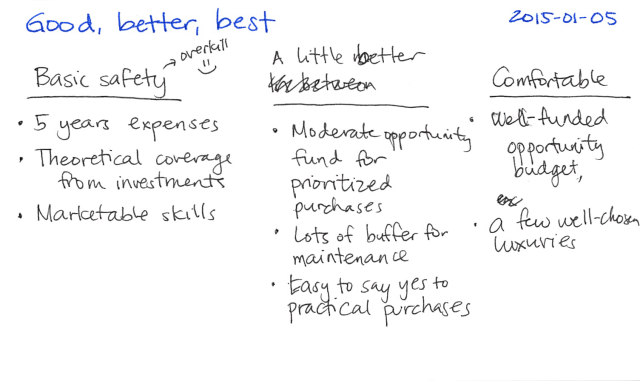
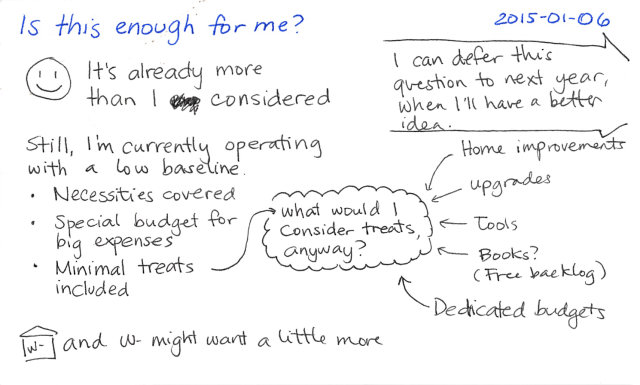
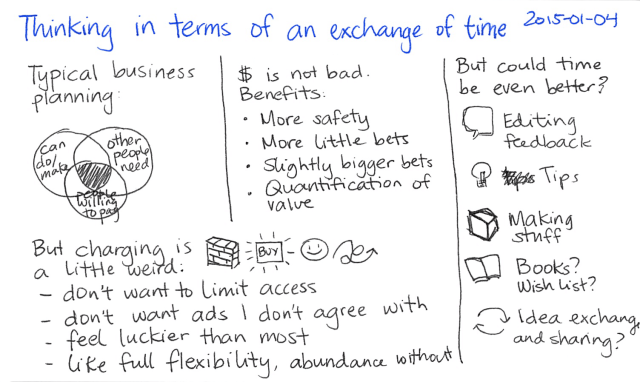
In the meantime, I’m making myself spend more (and spend more wisely), learning how to substitute money for time through connection, tools/automation, training,  and delegation.

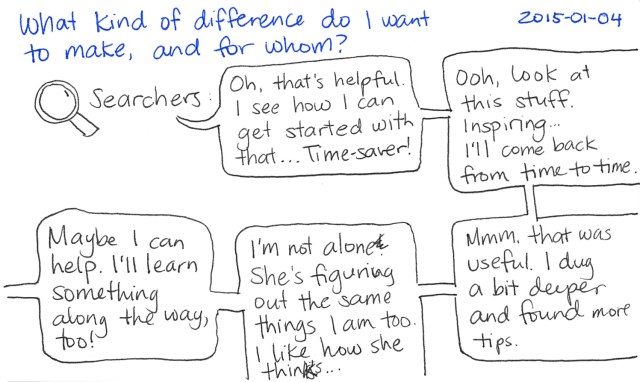
For example, I want to connect with other entrepreneurs and help them make things happen. I can wait for the Brownian motion of bumping into each other at tech events to gradually help me build that network. Or I can speed it up through lunches and coffees and follow-ups, especially if I take things beyond a perfunctory e-mail conversation and invest real time and energy (maybe even other people’s time and energy!) into helping people.

I want to try new tools to see which ones will support my workflow well. Sometimes that means paying for tools that turn out to be less than what I want, but the things I’ll gain from the tools that work out will more than pay for those.

I want to learn more about drawing, sales, business, and other skills that can help me make even more of a difference. I don’t want to just sign up for courses or coaching. I want to have a clear, action-oriented plan for implementing what I’m learning.

I want to learn how to delegate and to share the opportunities that come my way. That means that I’m going to slowly transition my processes over to other people, even if I think I can do it better or it doesn’t take me that much time to do it. I can always take those tasks back if I need to trim my budget, but if I can document my processes and learn how to take advantage of other people’s talents, I think I’ll be able to grow a lot more. Many entrepreneurs struggle with going beyond what they can do with their own time or talents. Knowing how to share the load – and better yet, building a network of people I can trust – is more than worth the investment. Besides, if I get better and better at delegation, and if I use that time productively, I can grow the business even more.

What can the 2012-2013 fiscal year for my business look like? I have four more months of consulting planned at three days a week (although I’m taking December off, so technically, that’s just three months of consulting). I have a professional speaking engagement in November. I’ve got the beginning of a possible business idea around sketchnotes, and I want to practise validating it. For that, I’m going to want to set up more lunches and start more e-mail conversations. And I’m going to follow up on that budget, seeing if I can invest money in growing.

Both business idea validation and investing in people/tools/processes involve risk. At the end of the next fiscal year, there’s a chance that my balance sheet will be slimmer – but also a good chance that I’ll have learned a lot along the way, and possibly at a rate cheaper than an MBA. Besides, who knows? I might turn those experiments into earnings too!

So that’s where I am and where I want to go. Thank you for being part of the adventure!

Short URL: http://sachachua.com/blog/p/23893

Sketchnotes: ENT101: Lived It Lecture – Bruce Poon Tip (G Adventures) on Social Enterprise

Click on the image for a larger version of sketchnotes. This talk is part of the free MaRS Entrepreneurship 101 series (webcast and in-person session every Wednesday!)

Feel free to share this! You can credit it as (c) 2012 Sacha Chua under the Creative Commons Attribution 2.5 Canada licence.

20121003 Entrepreneurship 101 - Lived It Lecture - Bruce Poon Tip - G-Adventures

Missed the first session? Check out my sketchnotes for Finding and Validating Your Idea (Keri Damen).

Liked these notes? They’re fun to do and I’m happy to share them. I learn, other people learn, everyone’s happy! If you want, you can set up some time for tea/hot chocolate/Skype/Google Hangout (or e-mail me your thoughts), tell me what you’re interested in, and help me in my quest to learn how to get really good at connecting the dots. =)

Looking forward to sharing more notes next week!

[Read more →]

Short URL: http://sachachua.com/blog/p/23787