6078 comments
2357 subscribers
6211 on Twitter
Subscribe! Feed reader E-mail

On this page:

ITSC guide to conference awesomeness

Darren Hudgins liked my Shy Connector presentation a lot, so he asked me to put together some quick tips to share with the ~400 people at the Instructional Technology Strategies Conference. Here’s what I came up with:

ITSC Guide to Conference Awesomeness

They’re going to play it live at the conference at 12 PST. =) I’ve kept it short so that I can share a few quick tips and then get out of the way of all that awesome networking. It sounds like a great crowd.

If you’re here from the ITSC, you might also be interested in my sketchnotes from David Zach’s keynote. Click on the image to see the full version.

image

Here are other pre-ITSC conference networking tips I’ve shared:

For more networking tips, check out:

The Shy Connector
View more presentations from Sacha Chua.

(Also see my full notes for the Shy Connector presentation and other blog posts about connecting)

I made the video with the guide to conference awesomeness using Microsoft Onenote, Microsoft Powerpoint, a Lenovo X61 tablet PC, Camtasia Studio 7 (which doesn’t get along perfectly with the Windows 7 on my tablet). I’d love to go back to the free Inkscape drawing program for drawing if someone can help me figure out how to get it to smoothly digitize. =) Thanks to IBM for sponsoring this effort!

Follow me on Twitter (@sachac) for more updates. I’ll be around from 12 PM to 1 PM PST to answer questions or share other tips. Use the #itsc11 hashtag or mention me by adding @sachac to your tweet. If you’re here after February 21, feel free to leave a comment on this blog post for Q&A. Hope this helps!

Short URL: http://sachachua.com/blog/p/22111

LinkedIn tip: Customize your profile URL

This tip’s for Mike Nurse and other people who are looking for small things that could make LinkedIn more useful for them… =)

Did you know that you can customize your LinkedIn URL to make it more memorable, writable, and professional?

  1. Log on to linkedin.com.
  2. Click on Profile – Edit Profile.
  3. Click on Edit next to your Public Profile URL.
  4. Click on Edit next to Your Public Profile URL. Choose a short, memorable URL. Click on Set Address.
  5. Optionally customize what people see on your public profile.
  6. Click on Save Changes.

If you want to make it easier for people to connect with you on LinkedIn, put your new URL on your business card, your e-mail signature, your website, and other social network profiles. Little things like that help make it easier for other people to connect with you.

Short URL: http://sachachua.com/blog/p/22100

On friendship and becoming more social

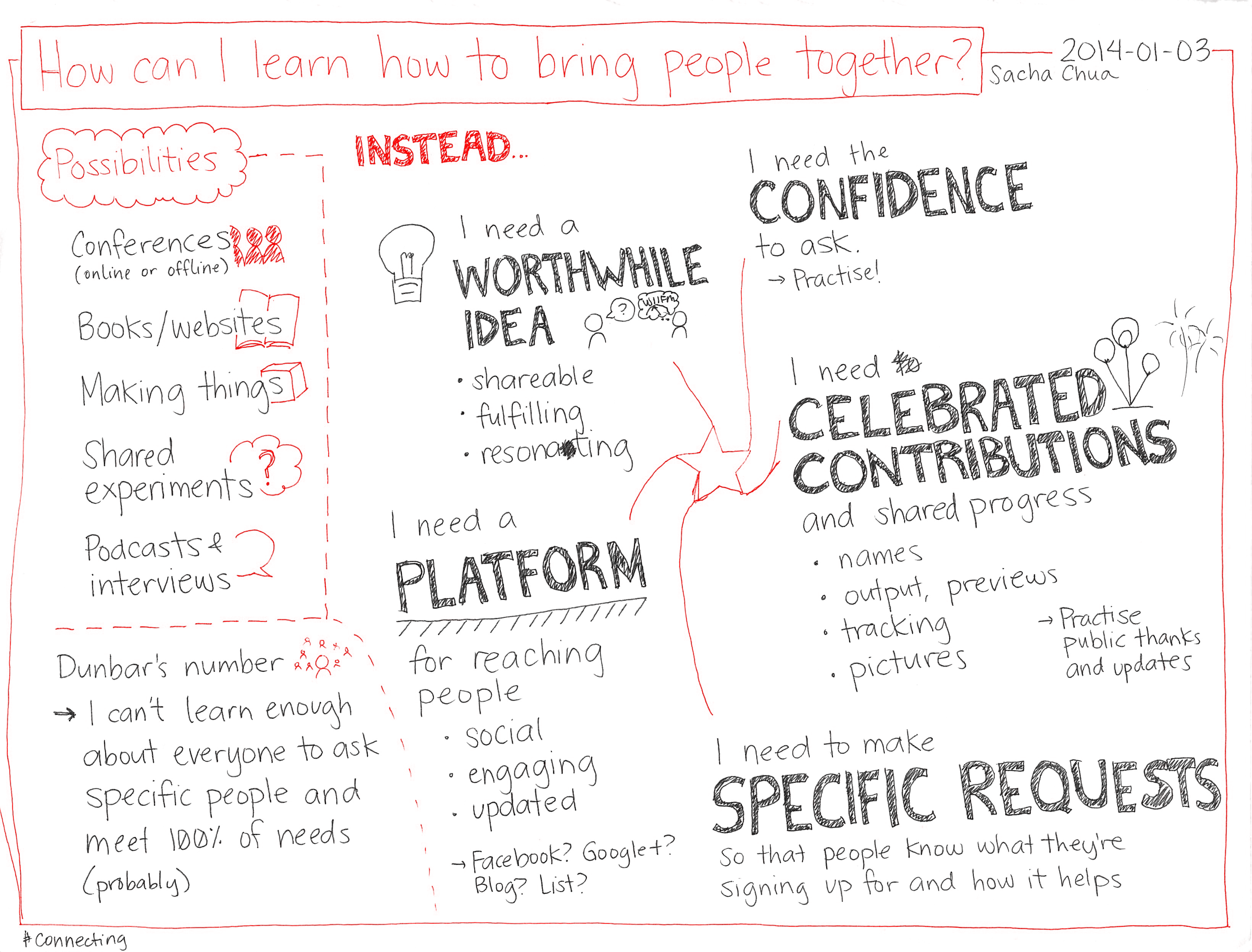
I’ve been talking to people about my project of becoming more social, getting better at connecting. It makes sense. I get to practise and pick up tips at the same time. =) Sometimes people say, “Sacha, aren’t you already pretty social? How big is your network, anyway?” But it’s not about that, and I think I’m starting to figure out what it’s about.

There are so many interesting people. W-, of course, is gosh-darn-awesome. And there are all these wonderful people I’ve gotten to know: my family, my barkada, my ninongs and ninangs, my friends in Canada who helped me get the hang of those first few winters, my friends at work and in various clubs, my friends through this blog and Twitter and all these other networks, and people I have yet to become good friends with. So the limiting factor isn’t the lack of people to develop friendships with, but my ability to do so.

What does it mean to be friends with someone? In the Nichomachean Ethics, where he devotes a book of fourteen chapters to the topic of friendship, Aristotle distinguishes between friendships of utility, friendships of pleasure, and friendships of good character. Of these, I’m interested in friendships of good character. In this kind of friendship, you appreciate the goodness of other people and they appreciate yours. You wish them good, and they wish you good as well.

One can’t have many friends at this level. In W.D.Ross’s translation of the Nichomachean Ethics:

But it is natural that such friendships should be infrequent; for such men are rare. Further, such friendship requires time and familiarity; as the proverb says, men cannot know each other till they have ‘eaten salt together’; nor can they admit each other to friendship or be friends till each has been found lovable and been trusted by each. Those who quickly show the marks of friendship to each other wish to be friends, but are not friends unless they both are lovable and know the fact; for a wish for friendship may arise quickly, but friendship does not.

And also:

Now there are three grounds on which people love; of the love of lifeless objects we do not use the word ‘friendship’; for it is not mutual love, nor is there a wishing of good to the other (for it would surely be ridiculous to wish wine well; if one wishes anything for it, it is that it may keep, so that one may have it oneself); but to a friend we say we ought to wish what is good for his sake. But to those who thus wish good we ascribe only goodwill, if the wish is not reciprocated; goodwill when it is reciprocal being friendship. Or must we add ‘when it is recognized’? For many people have goodwill to those whom they have not seen but judge to be good or useful; and one of these might return this feeling. These people seem to bear goodwill to each other; but how could one call them friends when they do not know their mutual feelings? To be friends, then, the must be mutually recognized as bearing goodwill and wishing well to each other for one of the aforesaid reasons.

That makes me think of several things. First, to wish good for other people, you should know them beneath the surface. It’s easy to say that I wish my friends to be happy, but knowing the specific things they consider pleasurable or good means I can share good experiences, find good gifts, or help people grow.

I’m probably an outlier in terms of writing and making it easy for people to get to know me through my interests. If I’m going to get to know other people, then I’m going to need to take the initiative and reach out, maybe slowly getting a sense of a person over time. I can get better at this by also, say, compiling notes on people’s expressed preferences. (Yes, I’m a geek.)

Second, friendship is reciprocal. I can feel goodwill towards many people, such as the people I’ve gotten to know through blogs. Some may even feel goodwill for me back, without my knowing. Friendship, I think, is when we both know it and that mutual understanding influences our actions.

I think that people are rather better at caring about me than I am at caring about them. This doesn’t mean I don’t care about other people as much. It means that I think other people are more thoughtful and are better at making a connection, and that there’s plenty of room for me to learn. Add to that the occasional asymmetry of knowledge and it can be a little awkward, but I’m getting better at getting past the awkward bit and just focusing on getting to know people more.

One of the things I’m particularly curious about is developing friendships online. When I listed people I might call if I needed a favour or I needed someone to talk to, I realized that there were some people I’ve never actually seen in person. I’d like to get even better at cultivating friendships online. From literature and other people’s examples, it’s clearly possible to develop deep connections beyond your geographic reach. With many of my friends outside Toronto – or infrequently met even in the same city – it’s something worth learning more about.

A lot of this is a matter of time: time to learn about people, time to share experiences, time to build trust, and so on. I can’t do much to speed things up. But it’s also equally a matter of attention – if I don’t invest that attention, then that time will pass without much effect.

Of course, reflecting on the Ethics, I need to be careful that people and friendship don’t become means. It’s not about checking off a little checkmark on my list of things to learn, or dissecting people and finding out what makes them tick, or chasing the pleasure of making someone’s day.

So that’s what I’m talking about when I say I want to get better at connecting or I want to be more social. It’s not about making sure I’ve “got my dance card filled”, or that I go out to at least one get-together each week, or even that I remember to host tea. I think it’s more about knowing people more so that I can appreciate their goodness and wish them good, and about building deeper connections.

2011-02-18 Fri 06:50

Short URL: http://sachachua.com/blog/p/22098

Imagine success for social media

I was talking to an independent consultant who wanted to get better at using social media to expand his network. I suggested that he put together articles and presentations that he can share with his contacts (mostly executives) that are useful and that they would probably share with the right people in their companies.

Thinking about this, I realized that imagining the ideal scenarios can help people recognize the value of investing in sharing knowledge or building a social media presence. You can say that sharing is important, or you can imagine a story that goes like this:


CEO of small business: Oh! It’s an e-mail from __. He always sends me useful information, so I’ll take a look at this one. Hmm, this whitepaper looks like something our company could learn from. Let me send it to the director in charge of that.

Director: Hmm, an e-mail from the VP, I better read it. Ah, an article that looks like it will help with one of the challenges I’m currently working on. Hey, this guy has some great tips. I wonder… Oh, he has a website with other articles and presentations! Great. I’m going to flip through the presentations that look immediately useful. I should probably bookmark this site so I can come back to it later. Hey, he’s on Twitter. Let me check out what he posts… He’s got an upcoming seminar – that looks interesting, maybe I’ll attend. I think I’ll follow him on Twitter so that I can hear about other updates. Hmm, maybe he can do some consulting for us for this project – that would save me a lot of time, help me get the results I need… (and if he’s as good as he seems to be, I’ll look like a star).

Someone else searching on the Net: Hmm, I need to learn more about ___ if I’m going to be able to deliver those results. Oh, here’s an article that might be useful. Those are good points. Let me save this. I wonder… ah, he has other articles and presentations. Those are useful too. Let me read them… I wonder if he’s available to do some consulting. Oh, look, he’s in Toronto too. That makes it easier. I should give him a call.


Think about what success looks like. Tell yourself a story about what could happen. It’s probably less about just increasing the number of your followers or posting at least one blog post a week, and more about actions and results. What’s that story? Walk through it in your head, check if it’s plausible, and identify the pieces you need to build in order to make it happen. Doesn’t investing in those pieces make more sense now that you can see how they’re related to your end goals?

That led me to think about the ideal stories I tell myself. When I write for my blog, this is what I hope will happen:


Me: “Ah! Now I understand things a little better. Let me go try that and see what happens. … Yup, that works, and here’s how I can make it even better.”

Someone: “I need to figure out something. Let me search… Hmm, that look interesting, let me try that. Hey, that works. Oh, that looks useful too. And that one! And that one! I’m going to add this to my feed reader. … Oh look, another post from Sacha. She reminds me that it’s possible to be cheerful and have fun doing awesome things. =) Hmm, I know someone who might find this useful too…”

Someone: “Can you help me with __?” Me: “I could’ve sworn I’ve written about that around here… Ah, there it is! Here’s the link.” Someone: “Awesome. Thanks!”


What are the stories you imagine, and what do those stories help you learn about what you can do to make them happen?

Short URL: http://sachachua.com/blog/p/22096

Pre-conference networking tips for the Instructional Technology Strategies Conference

This is for http://itsc.oetc.org . Thanks to Darren Hudgins for the nudge to make this!

Short URL: http://sachachua.com/blog/p/22072

Blogging and conference networking tips

I promised to put together tips for networking at conferences. While sketching out my ideas, I realized that my conference experiences have probably been very different from other people’s. I had a blog before I started going to conferences, and it was perfectly natural for me to use that blog to share my conference notes. I’ve also spoken at most conferences I’ve attended, which really makes it easier to connect with other conference attendees. All the other tips I can share (custom nametags, easy-to-spot outfits, business cards, notebooks, etc.) are icing on the cake. If I can get people to make the big change to writing or speaking (or both!), that will do far more for the value they get from conferences than any little tip I can share about where to wear the nametag. (On your upper right, if possible, near your shoulder, so that people can see it when shaking hands; barring that, close to your neck, even if it looks a little weird, so that people can see it in their peripheral vision instead of having to obviously glance down.)

Blogging and speaking are probably the two most intimidating things I can ask people to do in this context. Speaking seems like the harder one. There are only so many slots, and people have such hang-ups around public speaking. But we’ve also terrified most people out of posting on the Internet because of all this fuss about personal branding and the infinite memory of search engines. I’m very annoyed about this, because I think so many “social media experts” have done us all a disservice by telling people they have to present a perfect image.

But this is what I have to work with. People might like a few connecting tips (conference conversation openers: don’t go for the dead-end “what do you do?” that requires creativity or coincidence to get the conversation going; instead, use conversations as a chance to learn about other sessions and other people’s experiences, and create excuses to follow up by promising to share notes or follow up on ideas). How do I get people to the point where they can make more radical changes, such as starting a blog – even if it’s only for conference-related things?

Here is a list of conference-related blog post ideas:

Before the conference:

  • What sessions are you planning to attend? Why? What do you hope to learn? Post titles, session descriptions, speakers, and your thoughts.
  • Who are the speakers? Have they shared any presentations or blog posts related to what you want to learn? Post links and what you’ve learned. This might prompt you to revise your plans.
  • Can you find other attendees? Link to their plans and connect with them beforehand.
  • How can you share your thoughts after the session? Share any plans for post-conference presentations or conference reports.
  • Is there a backchannel for connecting with other conference attendees, like a Twitter hashtag you can search for and use? What are the best ways of discussing what’s going on?

During the conference:

  • What have you learned from the sessions you’ve attended? What were the key points, and what are your next actions? You can do a few bullet points or paragraphs per session, and organize your posts by day. If you have detailed notes, you might post one entry per session. You don’t have to take notes on everything, but write down what inspired you or made you think, what questions you want to explore, and what you want to do based on what you learned.
  • What have you learned from the conversations you’ve been having? What are the other sessions you want to look into later? What experiences have other attendees shared? What actions have you promised for following up?
  • Who else has shared their conference notes? Link to them and share what you’re learning from them.
  • What’s working well for this conference? What could make it even better?

After the conference:

  • Overall, what did you learn from the conference? What were the most important insights and actions you took away?
  • What value did you get from the conference? Was it worth the time and effort you invested into it? If your conference attendance was sponsored by an organization, what value did that organization receive? (This is a good thing to include in your post-conference report so that you can increase your chances of attending future conferences. ;) )
  • What actions are you planning to take based on what you’ve learned?
  • Who else has shared conference-related resources? Link to them and share what you’re learning.
  • How did your post-conference sharing go? Share your consolidated report or your presentation notes.
  • What new sessions would you like to attend at the next conference? What would it take for you to learn and present those sessions yourself?
  • What were the results of the insights and actions you had because of the conference? What new things did you learn when you put them into practice?
  • Now that you’ve acted on what you’ve learned from the conference, what new value has your conference attendance given you and your organization?
  • What are you learning from your ongoing conversations with the people you met at the conference?
  • What worked well for you? How would you make your next conference attendance even more worthwhile?

See, there are tons of things to write about that don’t involve trivial things.

I can’t think of anything that’s a better fit than a blog. Twitter and tumblelogs are a start, but they’re not going to cut it. Too short, too dispersed. Facebook updates are too protected. You want these notes to be picked up by search engines so that you can connect with attendees, speakers, organizers, people from your organization, people who are interested in the topic, and so on. A blog is an excellent way to do this, and it’s easy to start one on a site like WordPress.com.

You might have two sets of notes: a fuller set of notes for personal or internal use, and a set of notes without confidential information that you can share on your blog.

Bonus: If you share your notes through blog posts, you’ve got an instant excuse for following up with anyone you met at the conference. Something like “Hi! Just a quick note to say that it was great to see you at CONFERENCE NAME. In case you find these useful, here are my notes from the conference: LINK.”

And if they like what you’ve written and they want to keep in touch, you don’t have to rely on the fragility of e-mail communications that can stop if one person forgets or doesn’t reply. People can subscribe to your blog and keep up with your future updates, even if the next post is only when you share your plans for attending another conference.

See? Blogging and conferences make perfect sense.

But I still have to figure out how to get people past that instant reaction of “Oh, I could never do that, I’m not a blogger, I’m not a public sort of person, I don’t have the time to do this,” and it’s hard because I’ve never had to get over that hump myself. Yes, there was a point in my life when I wasn’t a blogger, and I’m still not a very extroverted sort of person. But because conferences are a weird combination of energizing and draining for me, and because I can’t bear to waste all that time listening without doing and learning and sharing, and because I hate imposing on conference contacts by trying to build the relationship through personalized e-mails instead of just starting it off with a gift of notes and a low-key way to stay in touch if they want to… I can’t help blogging and sharing.

I’ve promised to put together this collection of tips on connecting at conferences. I’m going to keep trying to figure out how to explain this blogging thing, because I want people to learn a lot from conferences and make great connections. Onward!

Short URL: http://sachachua.com/blog/p/22019

Conference tips: planning your attendance

Make the most of your conference by planning which sessions to attend.

Think about your objectives. What do you want to learn? What will be useful in the long-term? If your organization is sending you to the conference, it’s a good idea to confirm your priorities, objectives, and session selections with your manager, and to be clear on what you should bring back from the conference.

Look speakers up. You can often get a sense of how interesting a speaker might be with a quick web search. Does the speaker blog? You’ll get a sense of their speaking style and depth. Does the speaker share presentations on sites like Slideshare? You may even find presentations similar to the one you’re planning to attend, which will help you make better decisions about whether you want to attend the session in person.

Consider the alternatives. Do you want to attend a presentation, or can you learn just as effectively from blog posts or articles? Depending on your learning style, you might find yourself fidgeting as a presenter explains something that you could’ve just read. Look for sessions on topics that haven’t been written about yet, or topics where you have plenty of questions. Keep an eye out for sessions that promise plenty of discussion time instead of taking up the entire session with a lecture. You’ll get more from your conference experience if you can ask questions and learn from other people’s questions.

Coordinate with others. Do you know other people who are planning to go to the conference? Coordinate your schedule with others so that you can maximize your coverage by exchanging notes. If your coworker is attending a session on one topic, you can attend a different one.

Identify Plan Bs. Plan alternative things to do or backup sessions to attend just in case a session finishes early, is rescheduled, or is a bad fit for you. (See my tips on the hallway track at conferences.)

Share your agenda. If you have a blog, consider posting your session choices and objectives there, omitting sensitive information as needed. This might lead to conversations with other people who are interested in the conference, other people who are planning to attend, and speakers who can help you figure out if a session is the right fit for you. Speakers might even modify their sessions based on what they read.

Short URL: http://sachachua.com/blog/p/21959

Get the highlights as a PDF!

Stories from my Twenties: Highlights from a Decade of Blogging