6094 comments
2357 subscribers
6250 on Twitter
Subscribe! Feed reader E-mail

On this page:

Emacs, artbollocks-mode.el, and writing more clearly

Analyzing the text of my blog showed me that I use some phrases way too much. Fortunately, Emacs can shame me into writing better, thanks to Art Bollocks Mode. (Update 2012-06-16: I’ve forked it and cleaned up the naming conventions: https://github.com/sachac/artbollocks-mode)

Art Bollocks Mode monitors your writing and highlights words or patterns you may want to reconsider. It can detect repeated words which sometimes slip past proof-reading. It has a list of common passive verbs, making it easier for you to rewrite the sentences to use the active voice. It detects weasel words like “many” and “surprisingly”. It even comes with jargon catchers for art critics (“postmodern”, “ironic”, and so forth) – hence artbollocks-mode.el.

Whenever you use a phrase that matches its patterns, Emacs highlights it, turning it an ugly orange-on-white and underlining it for emphasis. You can still go ahead and write it, but at least the words jump out. Like this: it’s really pretty obvious…

image

I want to use it to write clearer notes and blog posts, so here’s how I’ve tweaked my configuration. Many of the items below are words and phrases I want to use less. Others are part of work jargon that I’m trying my best to keep out of my regular use.

(require 'artbollocks-mode)
;; Avoid these phrases
(setq weasel-words-regex
      (concat "\\b" (regexp-opt
                     '("one of the"
                       "should"
                       "just"
                       "sort of"
                       "a lot"
                       "probably"
                       "maybe"
                       "perhaps"
                       "I think"
                       "really"
                       "pretty"
                       "maybe"
                       "nice"
                       "action"
                       "utilize"
                       "leverage") t) "\\b"))
;; Fix a bug in the regular expression to catch repeated words
(setq lexical-illusions-regex "\\b\\(\\w+\\)\\W+\\(\\1\\)\\b")
;; Don't show the art critic words, or at least until I figure
;; out my own jargon
(setq artbollocks nil)
;; Make sure keywords are case-insensitive
(defadvice search-for-keyword (around sacha activate)
  "Match in a case-insensitive way."
  (let ((case-fold-search t))
    ad-do-it))

(Isn’t regexp-opt so cool?)

artbollocks-mode.el also includes some basic readability statistics like the Flesch reading ease and Flesch-Kincaid grade level. When I analyzed my blog contents without source code blocks (all the Emacs Lisp code snippets were throwing off my numbers!), it turned out that my blog hovers around 65 in terms of Flesch reading ease, or around the same as Reader’s Digest (as reported by Wikipedia). The Flesch-Kincaid grade level for my posts in 2011 was around 8.4.

I’d use artbollocks-mode.el’s tools for calculating word count and readability, except that Emacs ends up including source code blocks because Art Bollocks doesn’t know about Org Mode. I might be able to work around that by defining more advice or creating my own functions that extract the relevant text into a temporary buffer before determining the text statistics. I can leave that for another day, though.

I’ll experiment with making it part of org-capture-mode for now. If I find that getting editing feedback distracts me too much from writing, I’ll remove it from the hook and toggle it when I’m ready. Here’s the code to turn it on automatically for org-capture:

(add-hook 'org-capture-mode-hook 'artbollocks-mode)

Thanks to dotemax for tweeting about writegood and artbollocks-mode.el. Onward and upward!

Short URL: http://sachachua.com/blog/p/23072

Transcript: Blogging (Part 15): Tools to help you get started

Hat-tip to Holly Tse for organizing this interview! At the end of the blog series, I’ll put them all together in a text file and a PDF that you can read easily, and I’ll add insights you and other people might share along the way. =) (Find previous entries) Here’s the last chunk!

Holly Tse: We probably have under three minutes left. We’ve got one more question here from Carla, and it seems like the most appropriate question to end this. She’s asking, “What recommendations would you give on which blogging tools to get started easily?”

Sacha Chua: Whichever you find easiest. For most people, that’s either wordpress.com or blogger.com, or something like that. WordPress.com or blogger.com. The tools don’t really matter as much as the attitude and the ideas you bring to it. Some tools make it easier to post than others. Things like Tumblr or Posterous are also gaining in popularity. But what you really want to do is get into the habit of thinking, “What do I want to share? What do I want to learn?” Then you almost can’t help finding tools that fit the way that you work. That’s the main thing.

HT: WordPress or Blogger, but really, whatever works. Whatever works for you.

SC: I think the much more important thing there is the habit of saying, “Well, what do I want to learn? What can I share? What’s different about today? What do I want to remember?” That’s probably the best tool recommendation I can make – that mental tool of asking yourself those questions. Then writing–even if it’s boring, even if you feel awkward and gangly like a high school student trying to figure out what to put in an essay–write for yourself, and you’ll gradually figure things out.

HT: Yes. Very good. It’s not just about the technology. It’s about why you are blogging.

SC: It’s almost never about the technology. If there’s anything I can do to help you get started with that, get in touch with me. I’m @sachac on Twitter. You can follow the link from there to get to my blog if you want to, and you can leave comments on that too.

HT: Thank you very much for joining us this evening. I want to say to everyone who is listening to us or catching the audio replay (which is available for 48 hours after the broadcast), Sacha’s so enthusiastic about blogging, she convinced me to start blogging again, so… Yay! Congratulations Sacha!

SC: And this is where you repeat your blog URL so that everyone can check it out.

HT: Yes, so it’s hollytse.com – I have to spell it out, I have one of those names too – hollytse.com.

SC: I look forward to finding out about all these wonderful blogs… The blogs that you, dear listeners, are going to start or continue… I’d love to learn from you and your experiences too. We’re all figuring things out. No one’s a real expert, and we’re all going to learn from each other’s stories.

HT: Okay, great! Thank you so much! I hope everyone has a good evening and we’ll connect in the blogspace.

SC: Have fun!

HT: Thank you. Good night!

Tada! You can find this 15-part series at Discovering Yourself through Blogging, including a text and PDF version.

Short URL: http://sachachua.com/blog/p/22472

Transcript: Blogging (Part 14): Writing for yourself and writing for others

Hat-tip to Holly Tse for organizing this interview! At the end of the blog series, I’ll put them all together in a text file and a PDF that you can read easily, and I’ll add insights you and other people might share along the way. =) (Find previous entries) Here’s the fourteenth chunk!

Holly Tse: You also mentioned you’re writing to share with other people, but you’re also writing for yourself. What’s the kind of balance there…

Sacha Chua: In terms of the stuff I post, a lot of it is for me. A lot of the things I publish on my blog are there because I want to look back at this forty, fifty, sixty years from now, and I want to be able to remember bits and pieces and build on the ideas I had before. A lot of this is me. Some of it is answering other people’s questions, or putting things out there just in case it will help somebody searching sometime later.

There’s some public stuff on my blog, but there are also bits and pieces that are a bit rough right now, or that need some filling in, or that are incomplete and need some thinking about, or that are simply private because I haven’t figured out a way… Even if you’ve got a publicly okay version of the story, there are all these interesting bits and pieces that nobody would quite figure out, and there are all these stories I wanted to tell first. So I have these private notes too. I don’t have quotas for any of them. I write in the process of figuring things out, and then I figure out what’s the widest group I can share this with.

In fact, my mom used to tell me to e-mail her more often, and I was thinking, well, most of the stories that I’d probably e-mail in a family update are things I feel comfortable sharing on my blog. Again, that push towards sharing things as widely as possible… You never know what kinds of ripples they’ll trigger, what kinds of things you’ll learn from other people. Don’t worry too much about balance. Write. Post as much as you feel comfortable with. Feel free to keep private notes. That works too, especially if that helps you remember and understand things. Have fun.

HT: You must get a quite a number of comments on your blog. Do you answer all the comments? What’s your opinion on comment etiquette?

SC: I do try to answer most of my comments, but what I really really like is when people start answering each other in comments. That’s where I get to learn something extra new. When people comment with a question, one of the great things about that… If people e-mail me, I’m the only one who gets to see that, unless I post it to my blog afterwards. When people leave a comment on my blog–maybe they’re asking a question or sharing an insight, and sometimes that doesn’t require a response, such as when they’re sharing a story–and it prompts somebody else to respond to them, then we all win. That’s something I would never have thought of, it’s outside my experience, and yet I get to learn from it because I’m listening in on this conversation, and other people are too. I really like comments.

I would love it if people kept commenting–and people do. They comment about the most surprising things, even. I’d write about something like burning my pancakes, and I’d get all these comments, including lots of tips on how not to burn pancakes. It’s surprising to see what people resonate with and what people leave comments on. I’m so glad that facility is there. If it were just me talking at people, broadcasting, I’d be limited to what I know. If it’s just me replying to people’s questions, then they’re just limited to what I know. When the conversation is in comments, then everybody can see everybody else. Even better when it’s on other people’s blog posts that link to mine… The conversation does get a little bit harder to track, but it’s so awesome. Then you get to see people’s thoughts in depth.

For example, I’m going to post notes of this on my blog. After the teleconference, you can go to livinganawesomelife.com. If you search for lotus blossoming summit or if you look in my blogging category, you’ll find notes like this, and you can go through what other people have said. Or, ideally, if you’re going to write your own stuff, you can link to it. Then I can find your blog post or you can tell me, and I can respond to that too. There are all sorts of conversations going on at all sorts of levels.

HT: So that’s livinganawesomelife.com.

SC: That’s an easier to remember domain name. My name is harder to spell for most people. If you want to go to that too – sachachua.com.

HT: sachachua.com . It’s also on the Lotus Blossoming telesummit site.

SC: You can follow me on Twitter, too.

Tune in next Thursday for the next part in this series! I’ll add new entries to the Discovering Yourself through Blogging page to make it easier for you to find them.

Short URL: http://sachachua.com/blog/p/22460

Transcript: Blogging (Part 13): On frequency

Hat-tip to Holly Tse for organizing this interview! At the end of the blog series, I’ll put them all together in a text file and a PDF that you can read easily, and I’ll add insights you and other people might share along the way. =) (Find previous entries) Here’s the thirteenth chunk!

Holly Tse: This is a question that probably is worth asking again, because Charles has sent another question about your recommendation if you should write every day, or every week, or just write when the fancy takes us. He says, “I know that having a regular deadline or writing quota has a positive benifit.” Do you use any deadlines or quotas when you’re writing your blog?

Sacha Chua: In terms of choosing a quota for my blog – and I have a blog post about this called “One post a day” – my quota is actually in the reverse direction. I found myself so excited that I was writing so much… I thought, well, all these people are getting e-mails, and they’re subscribed to all this stuff… Maybe I should throttle it down to one blog post a day. If you stop and you think about it, you learn so much each day. You experience so much each day. If you don’t have at least one thing worth writing about each day, there’s more in your life that you can hack and improve. There’s so much going on each day. For me, blogging has become such a useful tool that I like writing every day.

Some days are a little slower than others. Maybe I have a hard time grasping for the right thing to say. I’ve posted my thoughts on grocery shopping, for example. For the most part, I just sit down and I think, “What did I learn today that somebody else might want to learn?” “What do I want to do to make things better the next day?” There’s always an opportunity to do this.

It all depends on your comfort level. You can write every week, every month, sporadically if you want to… On the other hand, if you flipped it around and you stopped thinking, “I’m going to have to blog; what do I blog today?” and you think, “Well, there’s so much happening in life; what do I want to write about most? What do I most want to remember? What do I most want to share?” You’re surrounded by stories. You’re surrounded by ideas. Then you just have to deal with the frustration of not being able to get it all out and into other people’s heads as easily as you want to do so! There’s just so much to write about. Write as often as you can. Write because it helps you, not just because you need to. Write as a way to have fun, and learn more about yourself and life and everything.

HT: Good answer. Basically, whatever works for you.

SC: Whatever works for you, but you know, this writing daily thing is actually really really awesome. Of course, I’m going to be nice. I’m not going to stand over you with a whip and say, “Back to work! You haven’t written your blog post for the day.” But life is just full of awesome amazing things. Even though it seems like sitting down and writing for fifteen minutes or thirty minutes is an interruption that takes you away from your day, if you flip it around–if you write in the process of doing something…

For example, if I’m working with a particularly knotty programming problem or I’m trying to figure out a difficult decision, I’m not waiting until the end, when I’m busy and other things demand my time; I’m writing in the process of figuring things out. Then, afterwards, it’s just: Can I tidy these notes up and share them with other people? Which parts am I saving in my private notes, and which parts am I sharing on my blog? That takes five minutes, ten minutes to clean things up for other people after I’ve been writing in the process of learning.

Something I’d recommend too: don’t just sit down and think, “I’ve got to write a blog post; what am I going to write about?” Use it to learn. Use it in the process of living. Then decide: Is this something I can share with other people? What can I do to this so that I can share it with other people? Then you’ll find that your life is full of material.

Tune in next Thursday for the next part in this series! I’ll add new entries to the Discovering Yourself through Blogging page to make it easier for you to find them.

Short URL: http://sachachua.com/blog/p/22471

Transcript: Blogging (Part 12): Two homes

Hat-tip to Holly Tse for organizing this interview! At the end of the blog series, I’ll put them all together in a text file and a PDF that you can read easily, and I’ll add insights you and other people might share along the way. =) (Find previous entries) Here’s the twelfth chunk!

Holly Tse: I actually wanted to ask you, speaking of looking forward and looking backwards, since this is a telesummit about Asian women owning your voices and sharing their voices with the world… Where were you born and what is your ethnicity?

Sacha Chua: I grew up in Manila. My mom and my dad and my middle sister are still there. It was actually very difficult to move to Canada in the first place. Coming from a tropical country from the Philippines… Oookay, winter is really scary. Anyway, I grew up in the Philippines. I love love love all sorts of things that I miss from there. Mangoes, and my friends, and all of that stuff… And of course, family and relatives… anyway, so. The Philippines! And Canada! Now I have two homes. I’m definitely Filipino. I will still cook with bagoong and patis and try to get by with… In Toronto, it’s fantastic. You’re surrounded by all the different ethnicities. I always hear Filipino accents around. It’s like being home except it occasionally gets cold. Anyway, that’s my story. I moved to Canada in 2005 to pursue my master’s because I was offered a scholarship, and hey, why not… And then I fell in love, which is rather inconvenient when you’re planning to move back home. So that kinda helped me tough it out until I discovered the trick to dealing with winter.

The trick to dealing with winter, by the way, is to call it baking season, and then to bake.

HT: Yeah, I’m originally from Toronto, I know how cold winter can be up there. I’m in California now, so I’ve turned into a softie now.

SC: You get no sympathy from me whatsoever if you complain about the weather. Anyway, that’s another the blog has really helped me. I’ve been writing about all these stories. I can tell how I grew out of most of my homesickness. Still hits every so often, but I can see those shifts. I can use these stories to keep in touch with my friends back home, and to make new friends here as well. It’s been really, really helpful for me. Even with Facebook and Twitter and Google Plus and all these other social networks, there’s still that need for a place to tell your own stories, share your pictures, and have these conversations without it being fragmented over all these different places.

I was glad that I’d gotten into writing, especially during those difficult times. I’m sure that whatever challenges come in the future, I will try best to write my way through them.

Tune in next Thursday for the next part in this series! I’ll add new entries to the Discovering Yourself through Blogging page to make it easier for you to find them.

Short URL: http://sachachua.com/blog/p/22470

Transcript: Blogging (Part 11): Looking back at the year

Hat-tip to Holly Tse for organizing this interview! At the end of the blog series, I’ll put them all together in a text file and a PDF that you can read easily, and I’ll add insights you and other people might share along the way. =) (Find previous entries) Here’s the eleventh chunk!

Holly Tse: We have another question here from Charles. He’s asking, “Can you comment on the benefit you’ve made by preparing yearly digests of your blog in PDF format and printing out your blog?” He says he always enjoys reading your annual review of your life.

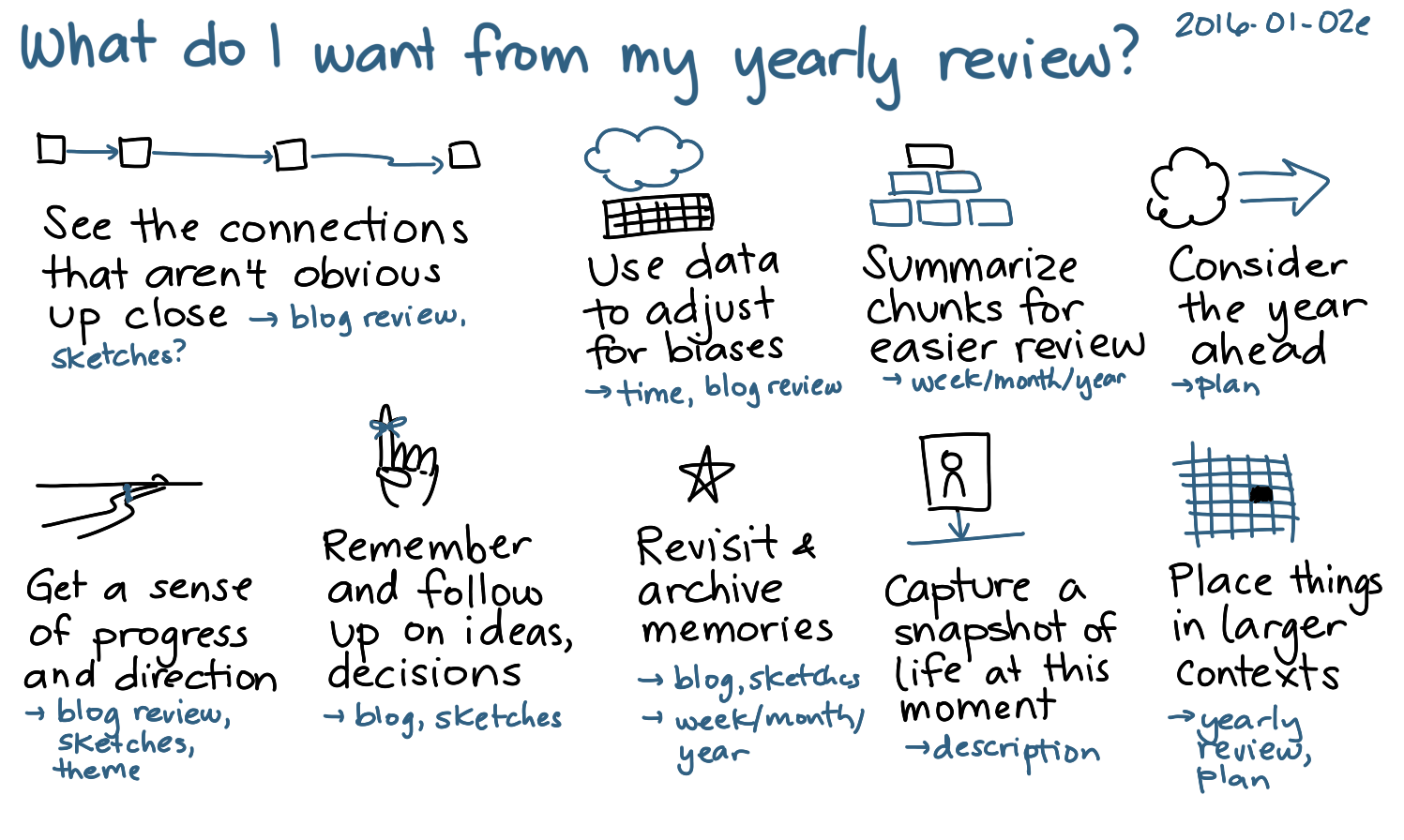
Sacha Chua: Awww… So I started keeping a paper backup of my blog after my mom inspired me, because she started printing out my stuff too. Also, it’s kinda fun to flip through what you’ve actually written. We don’t have any visuals now, but I’ve got this thick binder that’s maybe 3-4″ thick, double-sided printed paper with two columns printed on it, and all of that stuff… I’ve been writing for a while. You don’t have to write that much. It’s okay. But it is fun being able to look at it. Every year – sometimes twice a year, since I tend to do one around my birthday and I tend to do one around the Christmas/New Year holidays too – I look back at what I’ve done over the past 12 months, where I wanted to be by the time I would’ve done my review, and I match things up. What did I learn?

When I was doing my most recent review – when I turned 28 – I flipped back through my blog posts in August 2010, and I started just reading forward. As I went through things, I was, like, “Oh yeah, this was the year that we disassembled the washing machine and managed to successfully put it back together!” Yes. We had to do that to get the 27″ machine down a 26″ hallway or something like that. Anyway. It was quite an adventure, and the blog post is on my blog, of course. Little things like that, that I might otherwise be really fuzzy about remembering (“Oh yeah, we did this some time ago, but I don’t really know when”)… It was there, in my blog, and it reminded me about other things. Reading about all these things reminded me about things I hadn’t written down, but which has happened anyway. It’s like being able to take a step back and bring up all those different feelings and ideas and memories. It’s a fantastic thing, and I would never have thought that I’d enjoy writing that much.

Yearly digests. Even if you really just stop, look at what you’ve done, celebrate all these memories… See what you’ve learned that you can share with other people. Then think, okay, what do I want the next year to look like? What are some of the ideas here that I want to build on?

I’ve actually moved away from having bucket list sorts of goals. You know how people make lists: I want to climb Mount Everest, I want to dive in the Great Barrier Reef, I want to eat at a 5-star restaurant… I started feeling like that was like how people collect stuff, except this is collecting experiences. It’s cool for people who do that, but after lots of reflection (also on my blog), I decided it wasn’t really for me at this stage. In terms of saying, “What are the things I’d like to learn next year?” “What are the ideas I want to focus on?” Next year, I want to focus on slowing down and doing things deeply. Doing things well. Writing more. (If that’s even possible…) But writing, and polishing… I’ve gotten good at building things quickly, trying things out quickly… What can I do to make it easier for people to learn from it or make use of it?

Being able to sketch out this idea for myself, and then over the next few months, being able to go back and track how I’m doing with that — whether my goals still call to me or whether I want to shift to something else… Having that written down gives me the ability to do that, whereas doing some hand-waving or letting the months and the days just flow past without any kind of record… This is why people wake up and ask, “Where did my life go?” Well, when I wake up, I know where my life’s going, and I know where my life went, and it’ll be fun figuring out how much more I can do in the years ahead.

Tune in next Thursday for the next part in this series! I’ll add new entries to the Discovering Yourself through Blogging page to make it easier for you to find them.

Short URL: http://sachachua.com/blog/p/22469

Transcript: Blogging (Part 10): Difficult situations

Hat-tip to Holly Tse for organizing this interview! At the end of the blog series, I’ll put them all together in a text file and a PDF that you can read easily, and I’ll add insights you and other people might share along the way. =) (Find previous entries) Here’s the tenth chunk!

Holly Tse: I heard you mention a lot about a blog being about sharing stories. We have a question here about Charles from Sydney. He’s asking, “What happens when you blog about something that’s private or could offend others if you were to publish it?” For example, he wants to write a blog article about the bad manners he encounters at his workplace, particularly inappropriate use of smartphones. What advice do you have?

Sacha Chua: It’s a tough question, especially since even with how careful I am on my blog to not offend anyone, I’ve accidentally offended people before. One time I was writing about my teaching reflections. I was teaching computer science in university, and I was writing about what I was learning in the process. The example I often bring in here is the Sartrian existentialism we learned about in philosophy classes in school where when you make a choice, it’s as if you were choosing for everybody. In this case, my writing about what I wanted to do made this friend of mine feel that I was criticizing the way he taught. We had a bit of a fight about that.

In terms of offending people… Accidentally offending people, there’s not much you can do, because you can’t control other people’s reactions. When you’re writing about something sensitive that you know might offend people… I often like to step back and look for the really, really positive way to look at it. Not the fake-positive and not the constructive-criticism “I will smile as I will tear you apart” – which unfortunately is the way most people put constructive criticism – more along the lines of “This is what we’ve got. What are some small things I can do to make this better?” When you’re talking about what you can do, whether it’s… In terms of modifying other people’s smartphone use, maybe I’ll take my conference calls elsewhere, or maybe I’ll mentally rehearse different things that I can say to people in case their conversations are disturbing me.

When you’re focused on what you can do about it, then you come across less “this is what you should do” and high-and-mighty and whatever else. Trying to bring that incredibly positive “Well, here’s where we are; let’s figure out how we can move forward” approach to it will probably will do you much more good. It will probably make you feel better in real life also!

HT: Once again, it’s like using your blog to figure things out. In this case, it’s a way to take a step back and try to step away from the heated emotion you might feel, and to think of a way to constructively write it… and that might result in a constructive way to approach it in real life.

SC: That reminded me of a time when someone close to me said something pretty mean–thoughtlessly mean, but still pretty mean–to me. I stopped and I thought about it. I managed to slow down and respond nicely during the situation itself. Afterwards, also, I stopped and I thought about it. I thought, well, how would I like to respond in the future, too? Do I want to take the approach I did (stay calm, don’t take it personally, and all that stuff)? I realized that having that space – being able to decide what kind of response I’d like to have, and maybe even rehearsing some of the things I might do in the future when faced with a situation like this – really really helped. It’s like a fire drill. The next time you find yourself in a situation like that, you’re not going for the knee-jerk reaction. You’ve already thought: okay, for the kind of person I want to be, this is how I want to respond. And I want to respond with love, even though sometimes people have a harder time maintaining their self-control. It happens. People are human, and that’s okay.

HT: So I take it then that you blogged about the incident too.

SC: I did. I wrote about it because people run into these situations. If what I’ve written or what I’ve thought about can help somebody else put in that little bit of a gap between something bad happening–someone saying something mean to you, or someone doing something that annoys you–that gap between that stimulus and your response to it–and the quote by Victor Frankl is one of the things I used in that post as a point of reflection… Between that stimulus and response is our freedom to choose our reaction. Writing about it, thinking about it–bringing your conscious or more positive or more loving mind to bear on it–really really helps.

I should say that it is also possible to use all of this writing and blogging to descend into a vicious circle of feeling really really bad. For example, if you wanted to take this as an opportunity to rant about all the things that are going badly in your life, and how miserable you are and all that stuff… Being able to look back at your archive will probably make you feel a lot worse. It’s a powerful tool. Be careful with it. Try to focus on the things that you’d like to see, because people do tend to find what they’re looking for. I like to focus on the really really good stuff, and I’m surrounded by it, surprisingly enough.

HT: Very true. We actually had a speaker last week talking about the “law of attraction” and she basically says the same thing. From a spiritual, metaphysical perspective, what you focus on, you attract into your life. You’re a great example of someone who’s very positive, and you’re surrounded by positive influences.

SC: I wouldn’t go so far to call it the “law of attraction”, which I don’t quite subscribe to. I’d say that you get better at seeing the things you’re looking for. For example, if you’re writing about the things that you’re grateful for–which is a great practice, by the way, if you need cheering up or if you want to make your life extra happy–if you’re writing about the things that you appreciate and are grateful for, then you get better at recognizing and appreciating those things. If you write about how you want to improve things, then day by day, you’ll find more opportunities to improve your life. It’s amazing when you build that habit of asking yourself these questions, or looking for the bright side of things… You do get better and better at it. And why, yes, I do have a blog post about this too. I think I called it the martial art of happy-do.

Tune in next Thursday for the next part in this series! I’ll add new entries to the Discovering Yourself through Blogging page to make it easier for you to find them.

Short URL: http://sachachua.com/blog/p/22468

Get the highlights as a PDF!

Stories from my Twenties: Highlights from a Decade of Blogging

Free sample!