6098 comments
2357 subscribers
6263 on Twitter
Subscribe! Feed reader E-mail

On this page:

Experiment notes: Accounting, sales, and marketing–all the other parts of a business

When I started my experiment last year, leaving the familiarity of web development at IBM for my own adventures, I wanted to dig into several big unknowns that I had little experience with: the paperwork and accounting required for business, and the sales and marketing that’s even more crucial to business survival. I had tracked my personal finances and prepared our taxes for years, but business finances were new to me. I’d loved reading sales and marketing ever since I could clamber up my mother’s bookshelves, although my understanding was still abstract. So I expected to do favourably, but I was still a little nervous. After all, this was one of the key differences between an independent life and one inside a company. My experiences with this would determine whether I could survive on my own or whether I’d do better within a structure built by someone else. Would the benefits of managing my own business outweigh the overhead? Would the experiment be a long, hard slog, or could I get the hang of the fundamentals?

Accounting and paperwork was the first hurdle. I wanted to incorporate right away to have that separation between me and the company, so that any mistakes I might make wouldn’t bring us all down with it. It was probably unnecessary, but it was good to know that as long as I paid attention to the details, we’d be okay.

For the most part, D.I.Y. paperwork has been sufficient. I filed my articles of incorporation online, registered my company with the Canada Revenue Agency. It took me a while to sort out getting a business credit card, but it was straightforward once I did so. There were a few stressful evenings of forum research and fact-checking on government websites, such as when I decided to cancel my cellphone claims and ended up owing additional taxes. (It turned out to be just a few dollars’ worth.) Reading entrepreneur forums like the ones at Red Flag Deals helped me watch out for common pitfalls, such as the installment payments that automatically kick in after you reach a certain income tax threshold. I’m still postponing the paperwork needed to figure out how to get money out of the company. One step at a time.

I’ve grown to like that separation of saying, “This contract is between your company and my company,” or “The business will invest in buying ____.” It forces me to make decisions: is this worthwhile for the business? I have a trade name now, although I’ve kept the main company as a numbered company so that I can stick all sorts of other experiments underneath it.

If I were to do it again – or even now – I’d love to have an accountant whom I could e-mail questions periodically. I’d still want to keep a close eye on my books, and my transaction volume is low enough that I can handle things myself with Quickbooks. It would be good to have someone doublecheck things, though, and answer my questions.

One of the things that makes it easier for me is knowing that this too is an experiment, and that I can start up a different company with a different structure in order to try out other things. I don’t have to get everything gold-plated the first time around.

That’s the paperwork and accounting part of the business, which is usually a thorn in people’s sides, but which has turned out to be doable and even a fulfilling Friday afternoon routine.

Sales and marketing were other parts of business that I’ve heard many fellow geeks gripe about, so I wanted to find out what both of those were really like. Most freelancers I know have their plates full with referrals and repeat clients, and many don’t actively sell their services. I was lucky to have had clients for consulting and contracting right away, thanks to personal networks and my blog.

In the past few months, I’ve been making myself scale back consulting so that I can force myself to learn more about sales and marketing. Digital conference sketchnoting gave me a great excuse to try it out. Sketchnotes are visual. People have built businesses around this before. Businesses have bought services like this before, although generally in other cities. The sales approach would be to reach out to conference organizers and event agencies, while the marketing approach might involve posting sketchnotes and resources for organizers. Illustration is a complementary service, too, and there are other services I can cross-sell.

Here’s what I’ve come to enjoy about sales:

  • I like the process of mapping what I can provide (based on my own skills or including others) to what could create value for people.
    I like negotiating: cutting out the non-essential, adding options that people are curious about, and finding creative ways for everyone to get what they want.
    I like coming to an agreement on value and deliverables.
    I like receiving cheques and depositing them. Winking smile
    I’m even fine with following up and with turning down clients. Sometimes there’s a better fit elsewhere.

My marketing has been a gradual process of building up my website and sharing more resources. I enjoyed designing a logo and thinking about how to explain what I do. I’m glad I can build my own website and tweak it based on the ideas I have. New entrepreneurs are usually advised to outsource web design and development, but I think there’s value in creating my own simple site and evolving it over time. There’s still so much more to learn.

Looking back at this first year of my experiment, I think that the overhead of building my own business has been more than worth it. Many people see paperwork, sales, and marketing as distractions from the fun stuff, the work that they actually enjoy doing. For me, these activities are like programming, although in a slightly different form. It’s like learning more about the APIs (application programming interfaces) of the world, exploring the standards and specifications to find out what’s required from me and what’s possible. It’s like developing procedures, dealing with bugs, and improving algorithms. It’s like playing around with an interface until you figure out something that flows.

I’m glad I started this experiment. It’s difficult to imagine a career path within a company that would shift me from development (which I’m good at and which I still enjoy) to learning more about sales, marketing, and finance (which I’d have no qualifications for, and which I’d probably be terrible at in the beginning). It isn’t optimal. It doesn’t make sense. On my own, I can make that decision to temporarily give up some productivity in favour of building a useful combination of capabilities, and then see where I can go from there. I am less awesome a developer than I could have been if, say, I’d spent a year intensely working with Rails in a boutique web development agency, but this combination of tech and business and creative and communication will probably come in handy someday.

I think this will give me a great foundation for further experiments. I spent the first year of my experiment learning that it’s not that scary to create something and get to the first sale. I’d like to spend the next year getting even better at taking a business from the sparkle in one’s eye to a prototype that people can look at, sign up for, or buy, learning more and more about de-risking ideas. Then three years to see what I can do with those skills, and then my first evaluation: back to the world of other people’s ideas, or onward with developing mine?

I’ll still need to keep working on the fundamentals over the next year, of course. Some of the things I want to learn or practise include:

  • Moving money from the company to me (good for replenishing my opportunity fund!)
  • Elimination, delegation, and automation
  • Identifying prospects and reaching out to them
  • Following up with people
  • Building a library of resources not just for marketing but also because it’s good to share, like the way my blog has led to so many great conversations over the years

This experiment rocks.

Short URL: http://sachachua.com/blog/p/24405

Sketchnotes: The Very Versatile Drip–Mathew Sweezey (Pardot)

UPDATE: Dec 13, 2012 Want to watch the webinar? Here’s the video recording.

In this marketing webinar hosted by Pardot, Mathew Sweezey shared tips on setting up a drip nurturing program for marketing and sales support. Click on the image to view a larger size, and feel free to share this with attribution!

20121206 Pardot - The Very Versatile Drip - Mathew Sweezey

Pardot has many other webinars and recordings, so check them out if you’re curious about marketing automation.

Like this? Browse through my other sketchnotes, including my visual summary of The 5 Key Elements of a Better B2B Content Marketing Strategy by Nolin LeChasseur. I sketchnote technology/business conferences and presentations – if that sounds interesting, get in touch!

[Read more →]

Short URL: http://sachachua.com/blog/p/24140

Sketchnotes: The 5 Key Elements of a Better B2B Content Marketing Strategy–Nolin LeChasseur

Nolin LeChasseur of Brainrider shared these 5 key elements of a B2B content marketing strategy:

  1. Prioritize measurable objectives
  2. Articulate the business you’re in using customer terms
  3. Profile target customer segments
  4. Identify content that’s working now
  5. Develop content aligned with what your customer wants to know

Click on the image to see a larger version.
20121129 Brainrider - The 5 Key Elements of a Better B2B Content Marketing Strategy - Nolin LeChasseur

For more details, check out the slides and the video of a previous talk!

Like this? Check out my other sketchnotes for business- and technology-related visual summaries. Want me to draw for you? Get in touch!

[Read more →]

Short URL: http://sachachua.com/blog/p/24079

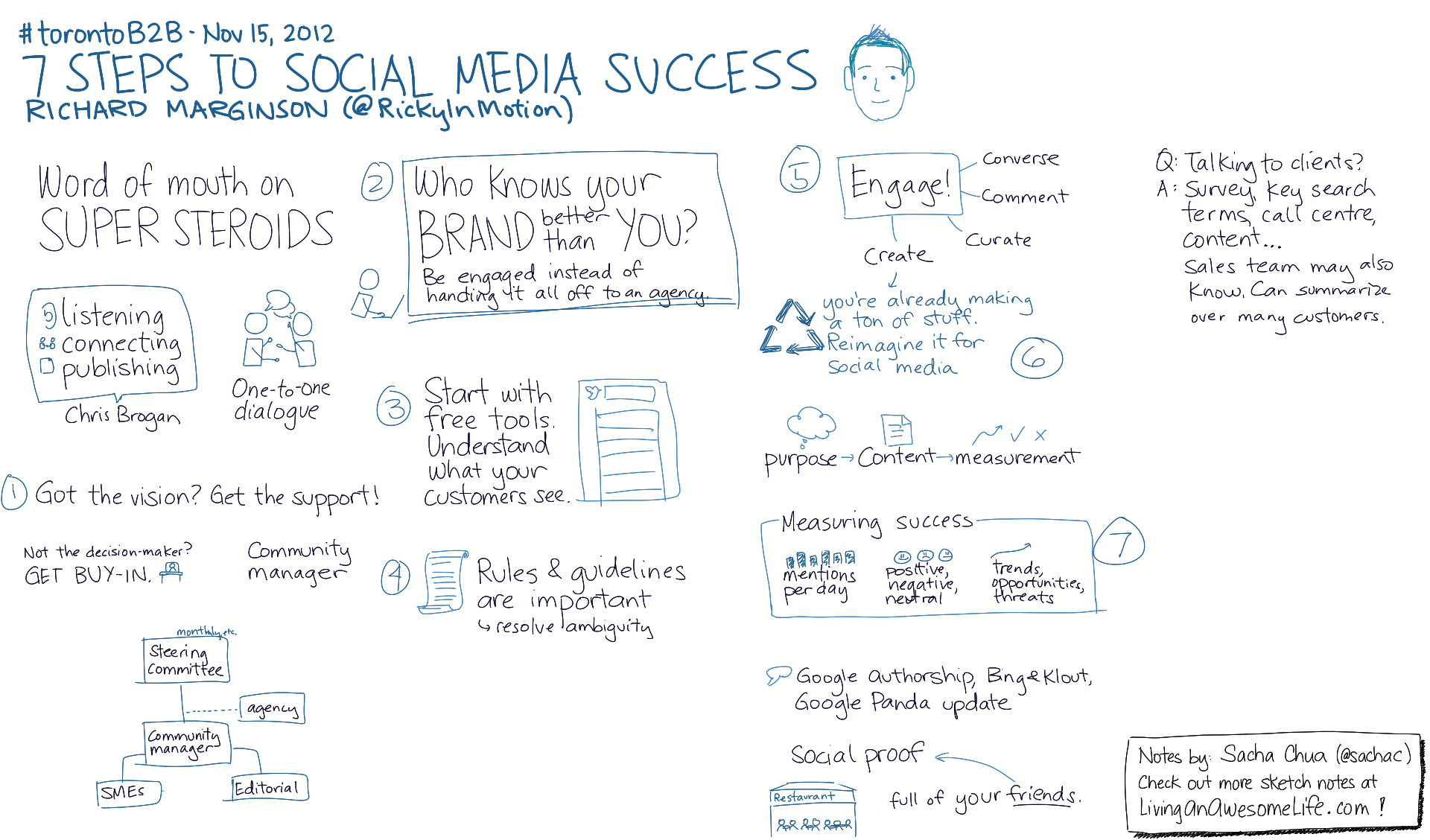
Sketchnotes from #torontob2b: Dragging an Organization into the Digital Age; 7 Steps to Social Media Success

Brainrider hosts these wonderful monthly meetups for marketers (digital and traditional) in Toronto. Click on an image for a larger version of the sketchnotes. Feel free to share these under the Creative Commons Attribution 2.5 Canada licence!

Dragging an Organization into the Digital Age – Sarah Major and Jeanie Hendrie

20121115 TorontoB2B Dragging an Organization into the Digital Age - Sarah Major and Jeanie Hendrie

7 Steps to Social Media Success, Richard Marginson

20121115 TorontoB2B 7 Steps to Social Media Success - Richard Marginson

Like these? Check out sketchnotes for previous #torontob2b meetups or my other sketchnotes!

[Read more →]

Short URL: http://sachachua.com/blog/p/24019

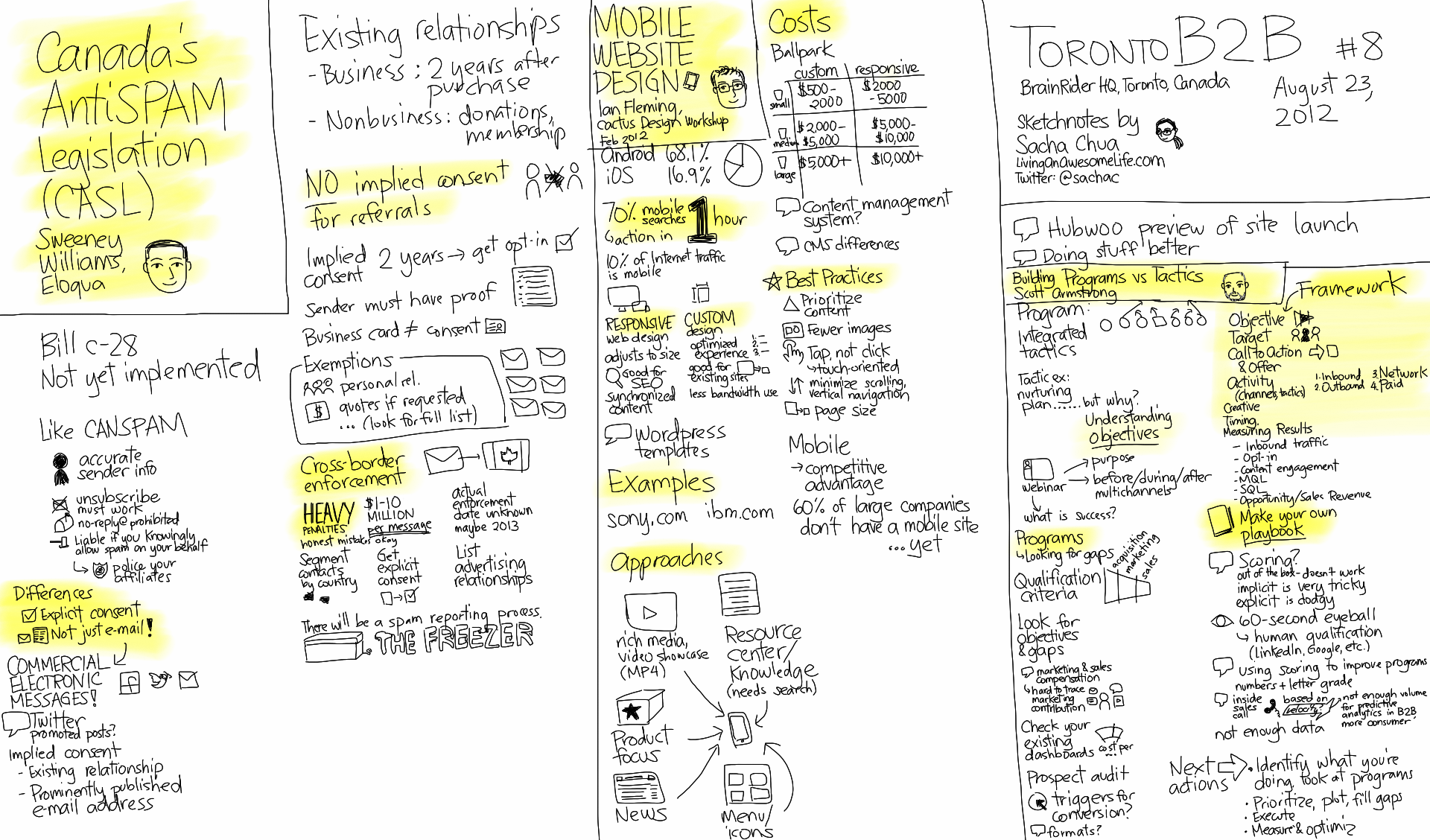
Sketchnotes from #torontob2b (antispam, mobile websites, marketing programs)

torontob2b-20120823-antispam-mobile-programs

Click on the image for a larger version.

At today’s TorontoB2B Marketers Meetup, Sweeney Williams told us about Canada’s upcoming anti-spam legislation, Ian Fleming shared different approaches to mobile website design, and Scott Armstrong talked about how they’re working on a program-based marketing playbook at Brainrider.

I’ve just put my Evernote sketchnote collection online, and you can browse and search within it on the Web. If you use Evernote, you can add the notebook and browse through it there. =) Enjoy!

Like these? Check out the sketchnote for the previous #torontob2b meetup (lead generation, Q&A) or my other sketchnotes!

Short URL: http://sachachua.com/blog/p/23677

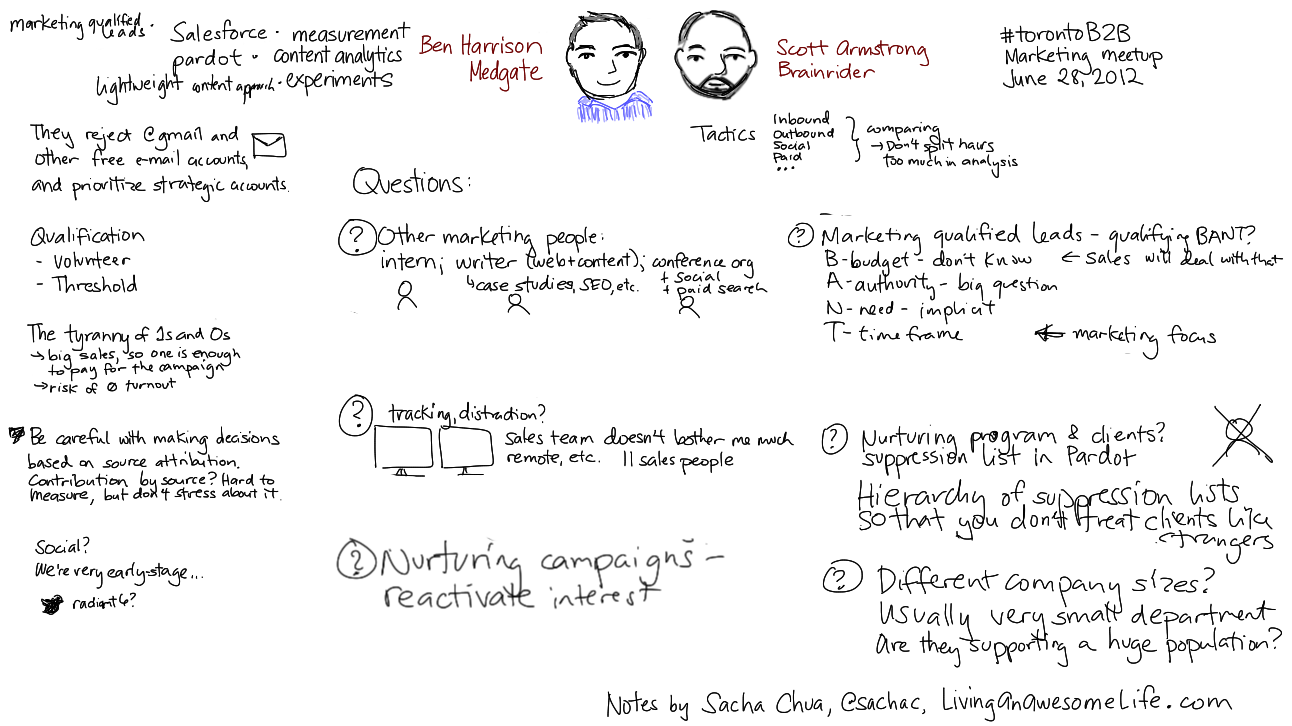
#torontob2b: Sean O’Donovan on managing content for lead generation + Q&A with Ben Harrison and Scott Armstrong

Update 2012-11-15: Here’s the video recap!

20120628 torontob2b - sean odonovan - managing content for lead gen

20120628 torontob2b - ben harrison and scott armstrong

Click on the images for larger versions. Feel free to share these under the Creative Commons attribution license.

In Sean O’Donovan’s talk on managing content for lead generation, he shared tips on mapping your content to the customer’s buying journey, repurposing what you have, and making it easier for people to find the information through metacontent and packaging. If you’re having someone else develop your content, it’s a good idea to ask them to develop the promotional materials for it too.

Ben Harrison and Scott Armstrong shared some of their experiences and opened the floor up for Q&A. It was interesting to hear about the marketing side of things.

If you like this, you might also want to check out my sketchnotes from the previous torontob2b meetup:

Other links:

To find out about the next #torontob2b event, check out Brainrider’s events page.

Enjoy!

Short URL: http://sachachua.com/blog/p/23535

Sketchnotes: Designing content so that it works – Carl Friesen (#torontob2b)

UPDATE 2012-11-15: Here’s the video recap!

Designing Content So It Works

Carl Friesen, Global Reach Communications

Like these? Check out my other sketchnotes, visual book notes/reviews, and visual metaphors.

Here’s the text from the sketchnotes to improve people’s ability to search for it:

Designing content so that it works

Designing content so that it works
Carl Friesen, Global Reach Communications

Website for e-book on content design showyourexpertise.com

1 2 3 4 5

stories

The Trend
Client wants customized solution
Show that you understand their world

1. Trend & historic causes
2. current situation
3. Thoughts on developments, reasons
4. Recommendations

The How-To
1.
2.
3.

Example: trustees, communication process

must be:
Relevant + Realistic
not necessarily what you do, but what clients will find helpful

Helpful!
- process with steps or
- a list of success factors

1. outcome
2. supplies/equipment
3. steps
4. avoiding pitfalls/problems

The How-to-Work-With
How to get good results from working with you

cannot be self-serving
include info on saving money
1. wild success experience
2. factors
3. advice


The Case Study
Leading-edge thought & sound implementation
Trans-Canada highway story
Wildlife protection

Not about showing how clever you are!

Must have learning points THEY can use
Must be a story
Tell with the client credibility

1. Initial situation
2. Steps
3. Problems & solutions
4. Lessons learned


The Survey
Shows that you stay in touch
must be what your audience cares about

More useful with a trend

Distribute appropriately
Level of detail
Consider limited distribution
The Opinion
informed opinion, thought leadership
at no charge

Long form
-situation
-views on good & bad aspects
-recommendations

The Review
-New product/service
-What’s different
-Discuss good/bad

The Comment

Notes by Sacha Chua, @sachac, LivingAnAwesomeLife.com

Short URL: http://sachachua.com/blog/p/23429

Get the highlights as a PDF!

Stories from my Twenties: Highlights from a Decade of Blogging

Free sample!