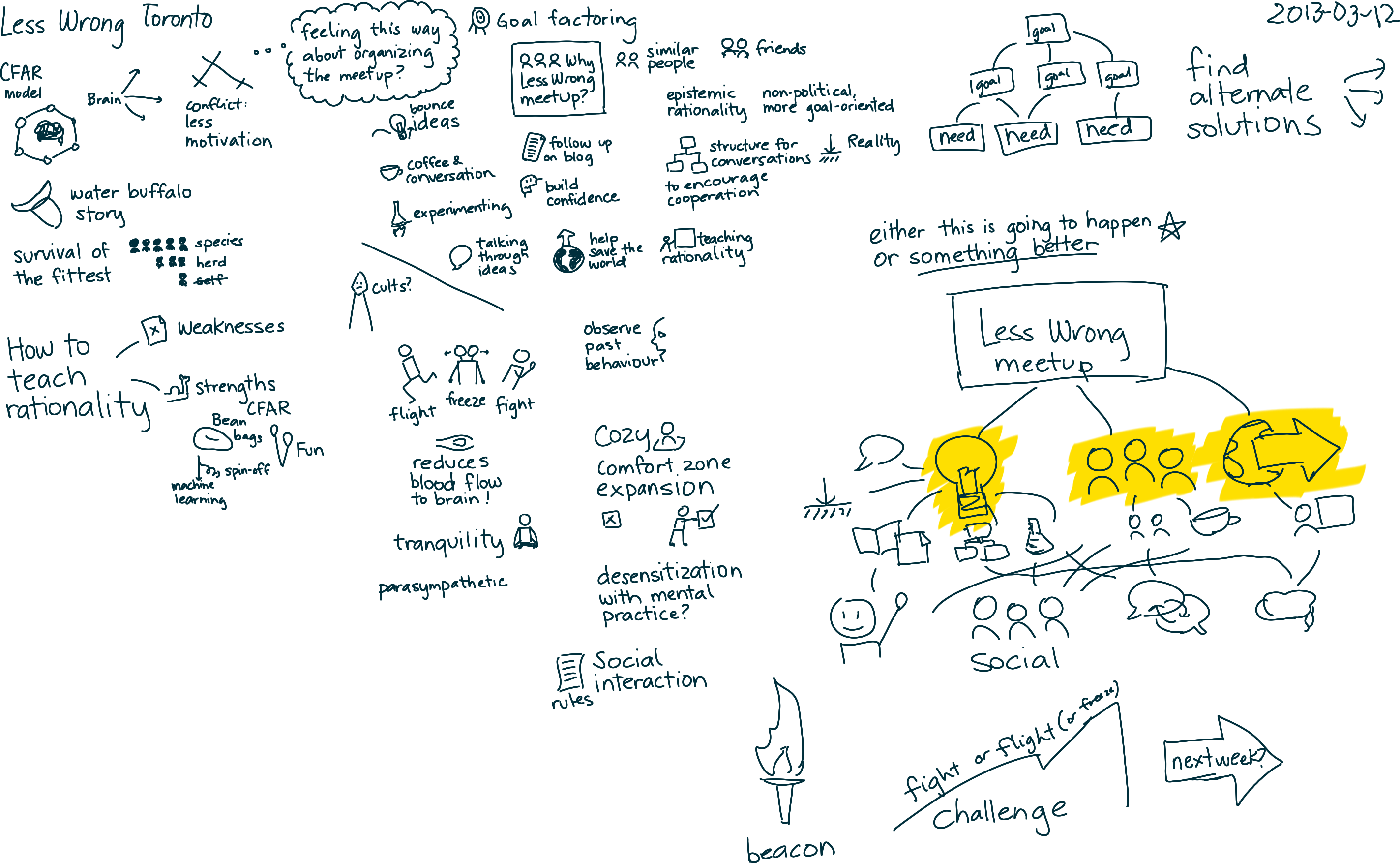
This week’s Less Wrong Toronto rationality challenge was about procrastination: observing how, why, and when you procrastinate, and what you can do about it.
The word “procrastination” comes from the Latin roots pro (“for”) and cras (“tomorrow”). The more I think about that, the more it seems that putting things off is actually a very useful skill, despite its negative connotations. There is only so much time in the day and so many years in a life. Figuring out what makes sense to do right now, what might make sense to do later, and what doesn’t make sense to do at all–that can be really helpful. To describe how we decide what to do later, we use the word “planning.” We reserve “procrastination” for when we put things off to our detriment, when we do low-value tasks instead of high-value tasks.
The Wikipedia article on procrastination describes procrastination as “replacing high-priority actions with tasks of lower priority” (emphasis mine), but I’ve been working on not letting perceived urgency mess up my true priorities. Thinking of it in terms of value instead of priority helps me not get caught up in false urgency.
Because the procrastinating mind can be good at rationalization (“I know I should write that blog post, but dinner needs to be cooked and the blog post isn’t that important anyway”), it can be difficult to recognize procrastination unless you’re obviously avoiding something. It’s easier to look at various decisions to put off actions, figure out the reasoning behind them, and look for patterns.
I put off many ideas by adding them to my Someday/Maybe list or scheduling them for the future. I’m working on getting better at finishing projects, so I try not to get too distracted from today’s to-do list unless it’s really important. Stashing other ideas in my Someday/Maybe list means that if I get blocked on all my current tasks, I can easily find something else that I might want to work on. Structured procrastination for the win! (Procrastination explanation: Low value compared to current tasks.)
I put off various types of tasks to certain days. For example, I balance my business books and handle other paperwork every Friday. If I need to get an invoice out quickly, I’ll do that any day of the week, but having one day set aside for paperwork and all those other little things makes it easy to keep the rest of my week clear. I put off worrying, too. I allow myself a chunk of time for planning and questioning, then focus in moving in roughly that direction the rest of the week. Mornings are great for code, afternoons for calls, and evenings for writing. On either Saturday or Sunday, we do our household chores and lots of cooking. Roughly sketching out our days like this helps me batch process tasks. (Procrastination explanation: Reducing impulsiveness / interruptions.)
I put off actions depending on my energy level. When focused and excited, I code or write. When I’m more contemplative, I like drawing or reading books. When I feel uncreative, that’s the perfect time to handle paperwork or do chores. When I’m optimistic, I flesh out my vision. When I’m pessimistic, I dig into my backup plans. (Procrastination explanation: Low value or expectancy; I expect to not code well if I’m preoccupied with something else.)
I absentmindedly put off putting things away. Not all the time, but enough times that this gets in my way. I have some workarounds. For example, I switched to using a belt bag because that was an excellent if unfashionable way to not lose track of my phone and my keys. I’m still working on slowing down, having one place to put things, and minimizing stress. W- has this saying, “One hand, put away” – put things away while you’re holding them instead of going back and forth. Working on it. =) (Procrastination explanation: impulsiveness.)
I put off going to the gym with W-, reasoning that I’m pretty tired from biking upwind and uphill. I should build upper-body strength and other things not covered by biking, though. One way for me to deal with this is by bargaining with myself: if I’m not going to the gym, I have to do kettle bells or similar exercises instead of spending the time writing. Or maybe I’ll train speech recognition on my computer so that I can increase the value of that activity… (Procrastination explanation: Low value because I don’t particularly like that form of exercise; low expectancy because of salient bad experiences, even though I’ve also had very positive ones.)
I put off shopping, especially when they are so many choices. I do this because I feel overwhelmed. I deal with it by limiting my choices based on predetermined criteria and focusing on items that meet my price thresholds. For example, I buy only flat/low-heeled shoes and machine-washable clothes. I eventually buy things when sales, thrift stores, or other buying opportunities intersect with my criteria. (Procrastination explanation: Low expectancy because of the feeling of being overwhelmed; low value because I have lots of things that still work for me.)
I put off learning skills if I think the costs associated with learning outweigh the benefits I get from doing so. For example, although driving is widely acknowledged as a useful skill, I haven’t gotten around to learning it because becoming a confident driver requires several big lifestyle changes: expenses related to cars, fuel, parking, and maintenance; I would need to shift my work to somewhere that requires a car-based commute instead of one that can be reached with public transit or biking; and I would need to get used to the thought of controlling this big, heavy, potentially lethal machine. The money I save by not driving can pay for quite a few cabs during the times that I do need to get around (say, accompanying a friend post-surgery). So far, clear costs (money! no free exercise from biking!) outweigh vague benefits (possibly being able to drive W- if he needs help, being able to navigate more cities). I’ll get to it when it makes sense. Or slightly before it makes sense. (Procrastination explanation: Low value.)
I put off putting some things off. Sometimes I feel myself getting annoyed for something I have to do. I could go round and round, internally whining about it, but sometimes it’s more productive to put off the annoyance, get things done, and then channel that annoyance into making sure that I don’t have to do similar things in the future. This actually works out quite well. (Procrastination explanation: Well, this is actually a useful thing…)
There are a lot of other things I procrastinate, but since I want to actually publish this blog post at some point, this is probably enough of a sample.
I use a lot of pre-commitment to deal with procrastination. I’m also halfway decent at recognizing when procrastinating something takes more energy and emotion than just doing the thing I’m procrastinating. I’m good at discovering (or even inventing) meaning for my tasks to make them more palatable. I need to work on being more conscious, though. All these techniques are useful only when I detect that I’m procrastinating. If I want to stop absentmindedly putting something down somewhere instead of putting it away, then I need to make putting things away automatic, and I need to get better at checking impulses.
There aren’t any big ominous tasks hanging over my head that I need to un-procrastinate, but I want to get better at catching unconscious procrastination. (Which was not quite the focus of the Less Wrong blog post on beating procrastination, but I lump it together with deliberate procrastination…) I’ll be focusing on being more mindful over the next month or so. It’s difficult to track how well I’m doing with this, so I track failure instead by recording “foggy” moments. I’ll probably never get rid of it, but I can develop more automatic behaviours to catch the common cases. One of the nice things about being married is that W- can help me catch things. =) Onward!