Growing authority
Posted: - Modified: | learning, planningIt’s good to think about the kind of life you want to grow so that when everything comes together – knowledge, skills, character – you can make the most of it.
I recently turned thirty. This is great. Being a thirty-something carries a little more gravitas than being a twenty-something. It’s not a magic bullet, but I think it will help. Maybe in my thirties, I’ll get better at using the Voice of Authority. Maybe I’ll figure out how to stop sounding like I’m five years old. Maybe I’ll stop hedging my blog posts and conversations with maybes and probablys.
I checked the mirror the other day. Still no crow’s feet. Gotta work on those. Every so often, I think about the way I want my face to wrinkle and age. Smile lines, yes. Frown lines, anger lines, not so much. Do you think it would be weird to find someone who can retouch one of my photos so that I’m more crinkly? Usually people want to go the other way around.
Anyway. Growing older has its perks. While I wait for the aura of respectability to settle in, I’m working on accumulating knowledge and skills. They’ll come in handy someday.
I was going to say, this girl looks like she’s 16, what does she know? … but she says she’s 29. A little better.

I think it’s about deliberately growing my circles of authority: understanding my limits and then gradually expanding them. Here’s a snippet from a recent HackerNews article that made me think about this concept of “authority”:
3. I built a bigger product than I had authority for
I started up Happy Bootstrapper in April with no followers or authority. I planned to write a book about metrics first. The reason is simple – I know my metrics, but I’m not a growth consultant or a SaaS owner. Starting with simple info-products would have bought me time to grow my authority at the same speed with my products.
Then I just happened to stumble into a problem/pain that I knew I could help people with. I didn’t stop to think if I had the authority to actually sell the product. And if you aren’t selling something trivial then you’d better have something to prove people that you know your topic. Teaching people about the topic does the job, but it requires time.
3 Lessons From My Almost Failed Launch
Authority isn’t just for selling things. It can help when asking questions or sharing thoughts. It’s like the way open source mailing lists strongly encourage people to show their work when asking a question. Don’t just ask a question out of the blue, show how you’ve tried to find an answer on your own. Experience (even a little bit) earns you conversation.
It’s also about making it easier for people to identify with you, which is essential if they’re going to listen. I did a lot of technology evangelism as a consultant, coaching teams and communities on social business and internal collaboration platforms. It was always about finding a few people within the group or in a similar group with whom people could identify. Few people were going to listen to me say that something was easy to learn. In many cases, I was the same age as their sons or daughters, and they were used to being confused by stuff that their kids found easy. If the advocate was someone in their group – especially someone who’s not always the first adopter of new things – it was much more effective. One of the most useful techniques for influencing people is Feel, felt, found: I know how you feel. I felt that way when… I found that… You can tell it with other people’s stories, but it’s more effective with your own.
As I go through life, I’ll probably collect more experiences that can help me identify with people and vice versa. I’ll probably also diverge (like with this semi-retirement experiment thing!), but with experience, I can get better at emphasizing similarities. It’s the ethos of rhetoric’s logos, pathos, and ethos: character is part of persuasion.
And I’ll learn more, too. I’ll learn things worth sharing. I’ll learn things that can save other people time or money, make ideas easier to explore, and so on. Here’s what I’m a semi-authority on (based on what people have asked me about) and my current limits:
- Emacs: getting started, playing around with it, some coding – but not yet working with Emacs core or doing lots of Emacs Lisp wizardry
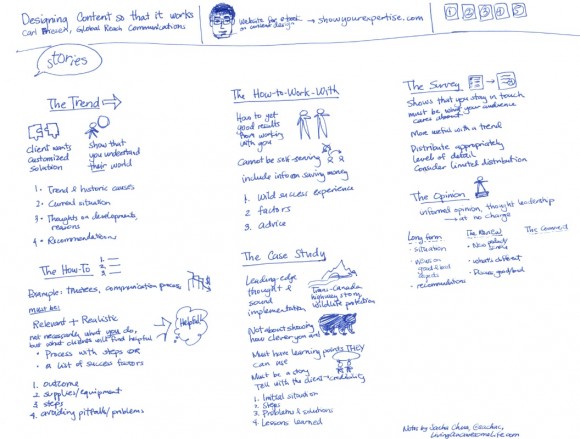
- Sketchnotes: getting started, working digitally, publishing, learning from others, using in presentations and blog posts – but not paper, and not graphic recording/facilitation
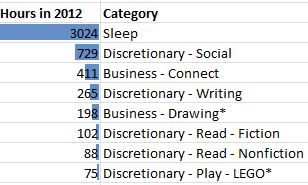
- Quantified Self: tracking time, analyzing data, working with Excel, basic stats – but not R, and only a few types of measures
- Blogging: learning through writing, blogging about tech and life, working with a large archive, adding sketches – but not yet e-books or other information products
- Bulk cooking: filling the freezer with individual meals (with an Asian slant), cooking frugally – but not vegetarian and not large-scale
- Hacking around introversion: connecting, taking notes, following up, speaking in public – but not networking events
I don’t want to turn into the “I know what’s best for you” sort of authority. I think good authority is more along the lines of being able to:
- empathize with people because you’ve been through something similar, and make it easier for them to understand where you’re coming from
- ask the right questions to help people think through things, share their experiences, and come to their own conclusions
- share experiences and pitfalls so that other people can avoid your mistakes or explore the secret bonus levels you’ve discovered
- enrich the conversation
What kinds of authority do I want to build?
I want to get really good at learning and sharing. I want to grok things and share what I understand. I want to inspire and help lots of people learn and share more effectively.
I want to get really good at working around my limits. That’s where Emacs, sketchnotes, Quantified Self, blogging, cooking, and introversion all fit in, I think. Emacs gets around the limitations of the tools I use. Sketchnotes and blogging help me get around the limitations of memory and introversion. Bulk cooking helps me get around the limitations of time. Quantified Self helps me get around the limitations of irrationality and forgetfulness. Not perfect, but useful.
I want to get really good at living life with equanimity. I want to weather the ups and downs and sidewayses of life. Frugality is a subset of this, I think – the ability to resist the temptations of consumption and desire.
So how can I build that kind of authority over the next few decades?
 Primary insights come from doing things. As Washington Irving said: “One of the greatest and simplest tools for learning more and growing is doing more.”
Secondary insights come from reading, talking to people, and learning from other people’s lives. I can make the most of being close to a library and speed-reading like crazy. Decent fill-in while I don’t have much experience.
At some point in time, maybe everything will come together. I wrote once:
If I can get a decade or two of great writing out right around the time I should have tons of experiences to write about, that should be fine.
Quantified Awesome: Time and building mastery
Let’s see how this works out. =)
Image credits: Brain tree: Christos Georghiou (Shutterstock), Book tree: Cienpies Design (Shutterstock)
What kind of authority are you building? How are you going about it?