Planning logistics and support for safe streets protests and rallies

| life, toronto

We attended the town hall on the topic "How are we going to protect our bike lanes?" It was wonderful to see hundreds of people thinking about concrete ways that they could help make things better. I loved seeing all sorts of people there, and even more that our 10-year-old daughter stood up to host a breakout session on a topic she cares about: supplies and repairs during protests.

Breakout topics

Here were the general topics for open space conversations and some notes on next steps (thanks to my husband for extra notes!):

  • rapid response: shift plan
  • organizing health care workers to protect our bike lanes: push media attention, union statements, op eds, journals
  • organizing parents to stand up for bike lanes: For Our Kids, virtual meeting, bike bus?
  • student organizing/University of Toronto Graduate Students’ Union (UTGSU): posters, stickers, town hall for students
  • Critical Mass organizing: new ride in May?
  • non-violent direct action: training on the 29th?
  • Bike Lanes 101: bring in new people, build people power, small group coffee chats, talk to the 905
  • engaging business: flip the script, owners, bia, consumers - be visible as cyclists, shopping passport
  • cycling winter: shovel bike lanes ourselves
  • connecting to opposition to highway 413
  • engineering reviews/critiques: will get drawings, make them public
  • future proofing: build few projects to high standards, accelerate construction, seamless network, push councillors, education, know what good infra is
  • federal level involvement: disallowance, cut bill 212, organize on ridings basis
  • website and digital infrastructure: Civic Tech Toronto
  • storytelling with data: isolate data for Bloor Yonge University lanes, bikeshare counts, ID core audience, biz owners, 905 drivers, common misconceptions, response, more data from city
  • guerrilla postering: creating a repository of art, setting up a mailing list
  • supplies and repairs during protest: coordinating supplies at the next protests/events
  • engaging drivers
  • organizing non-cyclists allies: open letter
  • safe complete streets: stop saying bike lanes, say complete streets, beautify, personal stories over stats
  • how to organize provincially
  • pressuring the city to not police protests: strategic mtg with councillors, pressure mayor, reduce police budget, testimonials from arrested
  • transit: TTC integration, free bike share pass?

Here are more notes on the parenting breakout and the supplies breakout that the kiddo hosted.

Parenting, families

I participated in the conversation on organizing parents to stand up for bike lanes. We talked about making protests and rallies friendlier for families and kids through hot chocolate, popsicles, bubbles, stickers, bike decoration stations, and other activities. People also exchanged ideas about organizing bike buses to help kids bike to school, meeting up with other cyclists at bike-friendly cafes during parental leave, and promoting bike education. We talked about widening the conversation from a focus on bike lanes to safety for everyone and connecting to what people care about, especially through personal stories and concrete life changes.

One of the triggers for the shift towards a stronger cycling culture in the Netherlands was collective outrage over so many child deaths in traffic accidents. I would like to get to that point without as many individual tragedies.

It's challenging to go to protests and rallies when you have to consider kids in tow. They get cold and hungry and bored and tired. They need to go to the bathroom. They need to be safe, especially when there's anger or aggression from people on the road or online. I wonder what can make it easier for families to come.

My husband and I have been going to quite a few of these events together with our 10-year-old. She likes offering people hot chocolate, snacks, and hand warmers: little ways to care for people who care about everyone's safety. I want to connect with other people so that we can figure out together how to make it easier for families to get involved. I am totally willing to start with hot chocolate and stickers. =)

Resources:

Supplies and repairs for supporting protests

I was surprised when our normally quite reserved 10-year-old suggested this open space breakout session herself, standing up in front of hundreds of people to invite them to a conversation about how to support protests through supplies and bike repairs. When she talked to the coordinator, she opted for a small space for about 5 people, but we ended up with about 10. She reported the results back to the main audience herself, too.

It's surprising how little things can go a long way to helping people feel more supported and taken care of. Our experience started by going to protests and offering people water refills, because it's important to stay hydrated. Most people have their own water bottles, but they might run out over the course of a few hours. We have cargo bikes, so my husband brings this huge container of water and refills people's bottles. As the weather got colder, we shifted to bringing warm water too. We're used to making hot chocolate for a crowd because it's a good way to keep kids warm during an outdoor play date. It's actually pretty delightful to see even adults light up when you offer them marshmallows with their cocoa. My husband's also been bringing bike repair tools, since quite a few people had to deal with flat tires from debris in contested bike lanes. Other people have even set up bike stands for check-ups and repairs. Other people have brought hand warmers and snacks. They pitched in with a variety of masks when the machines were grinding up the road surface. Little things help.

Sometimes having a list of ideas makes it easier for people to find one or two things they can contribute. We brainstormed a lot of little things that could help at these events:

  • table with snacks & info
  • warmth, water, and food
    • hot cocoa
    • hand warmers
    • popsicles in summer
    • water: water bottles, refills, hot water
    • pizza, samosas, etc.
  • tools
    • nametags? totally optional
    • signs, flyers, sign-making station
    • masks, PPE, first aid
    • bike repairs: tubes, tools → reach out to bike shops
  • info
    • info, contact, sign up
    • zines
    • sign-ups to coordinate with Bike Lane Watch?
    • nearby support sites: where to find bathrooms, nearby bike-friendly businesses to recommend
  • fun
    • kid activities, games, fidgets
    • stickers, sticker trading
  • other ideas
    • music
    • candles
    • someone to lock up and retrieve a bike if people get arrested
    • glow sticks, lights, batteries, chargers - Green P: power?
    • introvert corner
    • camp chairs, mats, tables
    • ways to reduce packaging, trash
    • moral support
  • $ funds
    • individuals sharing
    • tip jar?
    • that GoFundMe?

It might be nice to figure out how we can coordinate with other people who are thinking of bringing things or ordering things so that for example, if we're picking up pizza, we don't end up with too much pizza. Maybe the Telegram chat?

Sometimes the protest is on a sidewalk where there's not a lot of space to set up a table or cargo bikes. It might be a good idea to identify beforehand a park or a side street where we can set up some more support, so that people can go there to take a break before they go back into the fray. For example, when the protests were at Islington, we stayed at Tom Riley Park, and people came by to refuel as needed.

Is there funding? Quite a few people have offered, although it feels a little complicated. There has been some kind of fundraiser, but we haven't coordinated anything with them. People have also offered donations or suggested having a tip jar. For us, I think we're more comfortable just sharing what we can share as a gift (and avoiding liability! =) ). I love how other people have, on their own initiative, brought samosas and naan bread and pizza and sesame crisps and Timbits. More potluck than catering.

People suggested putting together some pre-packed boxes so that they're easy to grab and go as part of a rapid response to the anticipated bike lane removals next spring. Maybe that's like how we keep a large bag with cups, marshmallows, stir sticks, and hot chocolate mix, so that could be a starting point.

Tomorrow, Friends and Families for Safe Streets is organizing a memorial at 4:30 PM at Tom Riley Park on Nov 15 (parking lot near Bloor and Aberfoyle Crescent) as part of the World Day of Remembrance for Road Traffic Victims. We hope to be there. If you want to come and help figure out the logistics of caring for people at these rallies and events, drop by, say hi, and have some cocoa!

View Org source for this post

Notes from "An Evening with Valérie Plante" (Nov 13, 2026) - climate action, Montréal, municipalities

| life, toronto

I went to An Evening with Valérie Plante to learn about her experience in prioritizing the environment during her two terms as the mayor of Montréal. It was interesting to hear about the sponge parks that they built in order to absorb excess rainwater, designing pedestrian streets for beauty and comfort, the importance of connecting with public transit, and how they built an express bike network as part of improving safety for everyone, including the data they collected in order to make the case.

Her key tips were:

  1. Build partnerships
  2. Support citizens' initiatives
  3. Connect with what people care about

Here are my notes:

Feel free to use/share them!

More about Valérie Plante

View Org source for this post

EmacsConf: recording and re-recording introductions

| emacs, emacsconf, subed

I record brief introductions for all the EmacsConf talks so that they can be played automatically. That way, hosts don't have to worry about pronunciations on air, and there's one less changeover that might introduce technical issues. We can cut to the next talk a bit abruptly because everything runs off a crontab-powered schedule to keep things running on time on multiple tracks, so it helps to have a little transition between Q&A and the next talk. It's also nice having some kind of pronunciation reference so that when people discuss the talks or even just think about them with their internal monologues, they might have a better sense of how to say the speakers' names. We ask speakers to say their names at the beginning of their presentation, but people don't often include their last names, so the intro gets that consistently. The intro videos are available on the talk pages after the conference, and I've occasionally used them to remember how someone's name is pronounced.

Here's an example intro from EmacsConf 2025:

Here's my process for preparing those intros with Emacs.

First, I create all the intro slides with LaTeX and TikZ using the function emacsconf-stream-generate-in-between-pages from emacsconf-stream.el. This year, the template I'm using is _template.tex and the background image is _template_bg.pdf. I used to use an SVG and just replace the elements within it (template.svg, emacsconf-stream-generate-in-between-page-svg). This year, some of the talk titles are very long and SVG doesn't have widespread support for wrapping. LaTeX handles wrapping and positioning beautifully. This even allows me to have ligatures like the "ff" in Jeff Trull's name. I noticed those ligatures disappeared when I used Inkscape to convert to PNG, so I needed this command instead: inkscape --pdf-poppler --export-type=png -w 1280 -h 720 --export-background-opacity=0 --export-text-to-path

This is the function that generates the individual intro slide:

emacsconf-stream-generate-in-between-page: Use LaTeX to generate the intro slide for TALK based on assets/in-between/_template.tex.
(defun emacsconf-stream-generate-in-between-page (talk &optional prev info force)
  "Use LaTeX to generate the intro slide for TALK based on assets/in-between/_template.tex."
  (interactive (list (emacsconf-complete-talk-info)))
  (let* ((prev (or prev (emacsconf-previous-talk talk info)))
         (dir (expand-file-name "in-between" emacsconf-stream-asset-dir))
         (template
          (with-temp-buffer
            (insert-file-contents
             (expand-file-name "_template.tex" dir))
            (buffer-string)))
         (default-directory dir))
    (write-region
     (emacsconf-replace-plist-in-string
      (list
       :current-title
       (or (plist-get talk :title) "")
       :current-speakers
       (or (plist-get talk :speakers) "")
       :current-details
       (format "%s\\\\\n%s"
               (or (plist-get talk :absolute-url) "")
               (pcase (plist-get talk :q-and-a)
                 ((rx "live") "Live Q\\&A after talk")
                 ((rx "pad") "Etherpad")
                 ((rx "IRC") "IRC Q\\&A after talk")
                 (_ "")))
       :previous-title
       (or (plist-get prev :title) "")
       :conf-name emacsconf-name
       :conf-year emacsconf-year
       :previous-speakers
       (or (plist-get prev :speakers) "")
       :previous-details
       (format "%s\\\\\n%s"
               (or (plist-get prev :absolute-url) "")
               (pcase (plist-get prev :q-and-a)
                 ((rx "live") "Live Q\\&A after talk")
                 ((rx "pad") "Etherpad")
                 ((rx "IRC") "IRC Q\\&A after talk")
                 (_ ""))))
      template)
     nil
     (expand-file-name (concat (plist-get talk :slug) ".tex") dir))
    (shell-command
     (format "lualatex -shell-escape %s && inkscape --pdf-poppler --export-type=png -w 1280 -h 720 --export-background-opacity=0 --export-text-to-path %s"
             (expand-file-name (concat (plist-get talk :slug) ".tex")
                               dir)
             (expand-file-name (concat (plist-get talk :slug) ".pdf")
                               dir)))))

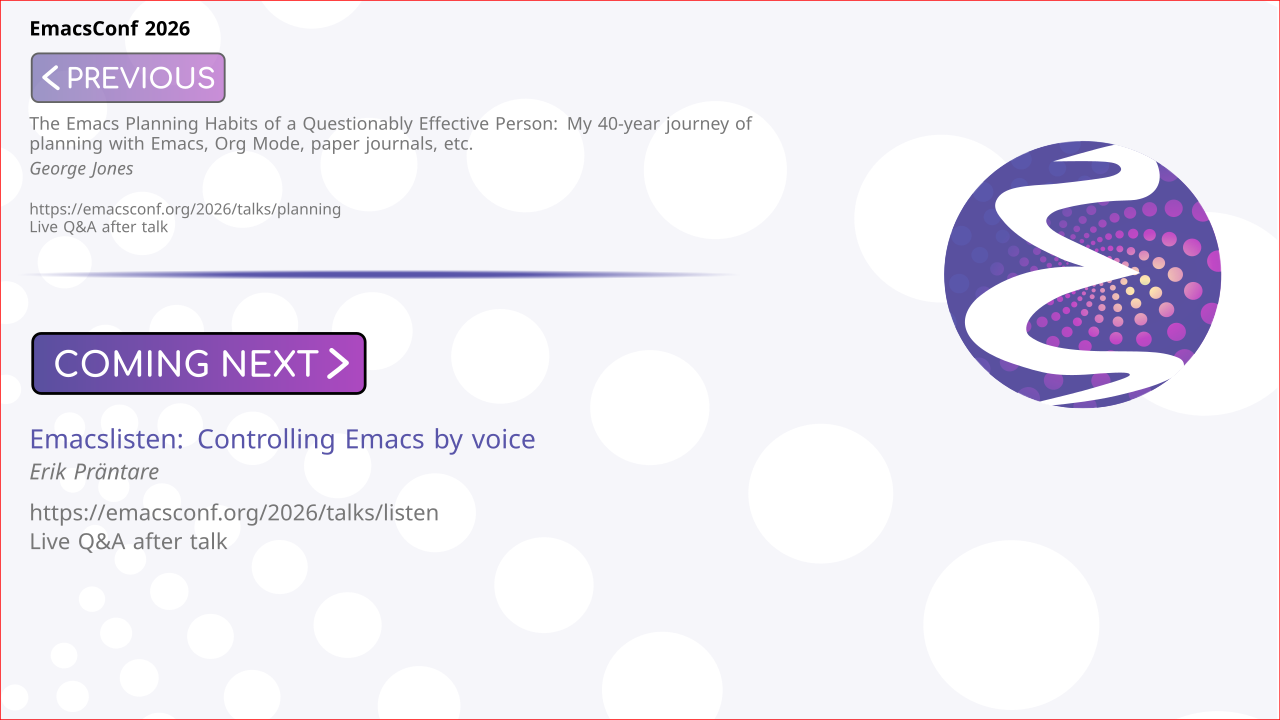
and here's an example slide it creates:

listen.png

Once I had the intro slides, I prepared my script. I called emacsconf-subed-intro-subtitles from emacsconf-subed.el to create a VTT captions file that starts like this:

WEBVTT


NOTE
#+OUTPUT: emacsconf-2026-sat-open--saturday-opening-remarks--sacha-chua--intro.webm
[[file:/home/sacha/proj/emacsconf/2026/assets/in-between/sat-open.png]]

00:00:00.000 --> 00:00:00.000
Next, we have "Saturday opening remarks",
by Sacha Chua.
You can ask questions via Etherpad.

NOTE
#+OUTPUT: emacsconf-2026-planning--the-emacs-planning-habits-of-a-questionably-effective-person-my-40year-journey-of-planning-with-emacs-org-mode-paper-journals-etc--george-jones--intro.webm
[[file:/home/sacha/proj/emacsconf/2026/assets/in-between/planning.png]]

00:00:00.000 --> 00:00:00.000
Next, we have "The Emacs Planning Habits of a Questionably Effective Person: My 40-year journey of planning with Emacs, Org Mode, paper journals, etc.",
by George Jones.
You can ask questions via web conference by joining from the talk page
or ask questions through Etherpad or IRC.

The text is based on the Org entry properties for each talk in our conf.org file. It used subed-record directives to define the output files and the visuals.

Then I used subed-record to start recording each segment. I pressed <left> (subed-record-retry) to re-record a segment as many times as I needed to. This adds or updates an #+AUDIO directive that points to the current recording and it also updates the timestamps. When I was satisfied, I pressed <right> (subed-record-accept-segment) to update the ending timestamp and move on to the next segment to record. Whenever I needed to take a break from recording, I used RET (subed-record-accept-and-stop) to accept the last segment and stop. After recording, I used subed-waveform-show-all to see the waveforms for each segment. I left- and right-clicked on the waveforms to refine the start and end timestamp, getting rid of the sound from the keyboard shortcuts, and I used subed-split-subtitle to split each long cue into the proper lines for the subtitles.

Here's the livestream where I worked on some of the intros.

After editing the audio this way, I used subed-record-compile-video (C-c C-c after subed-record-set-up) to create all the videos by using compile-media and FFmpeg. I could also regenerate just one or two videos by selecting the region and then using the same function..

Once the videos finished, I uploaded them to our password-protected backstage area, and emacsconf-publish-backstage-index added them to the page.

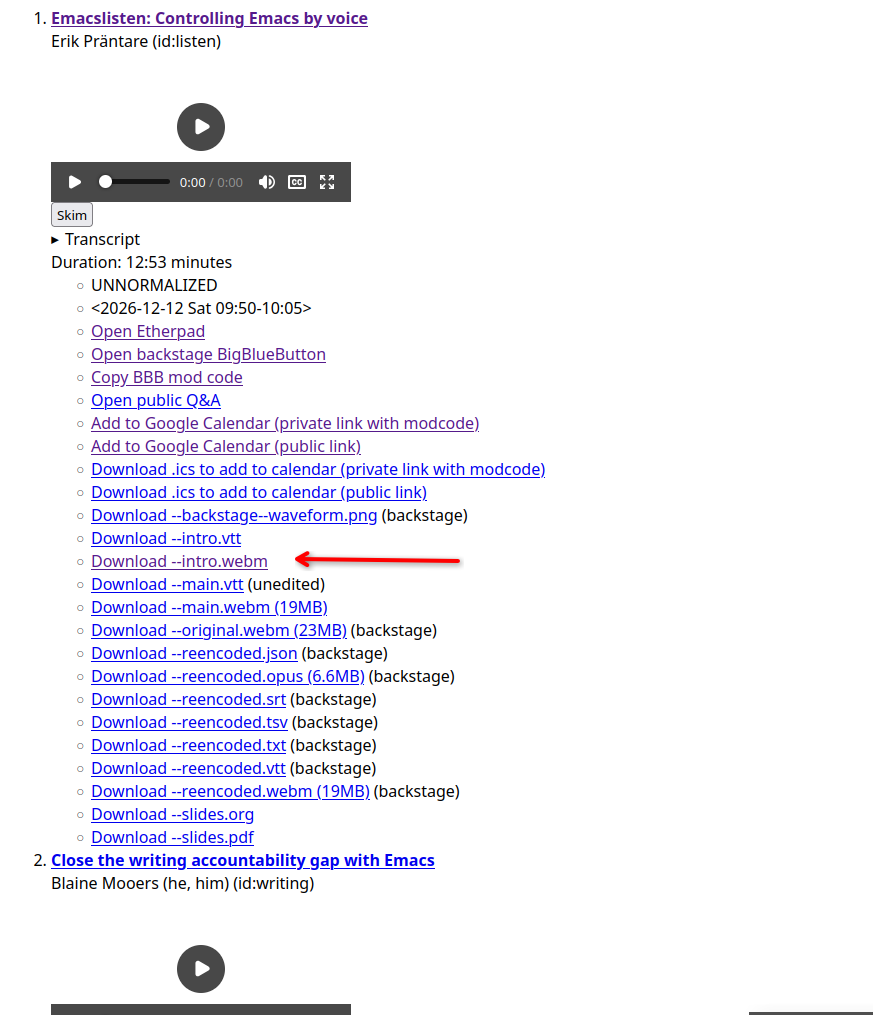
2026-11-12_09-25-45.png
Figure 1: Backstage links to intro

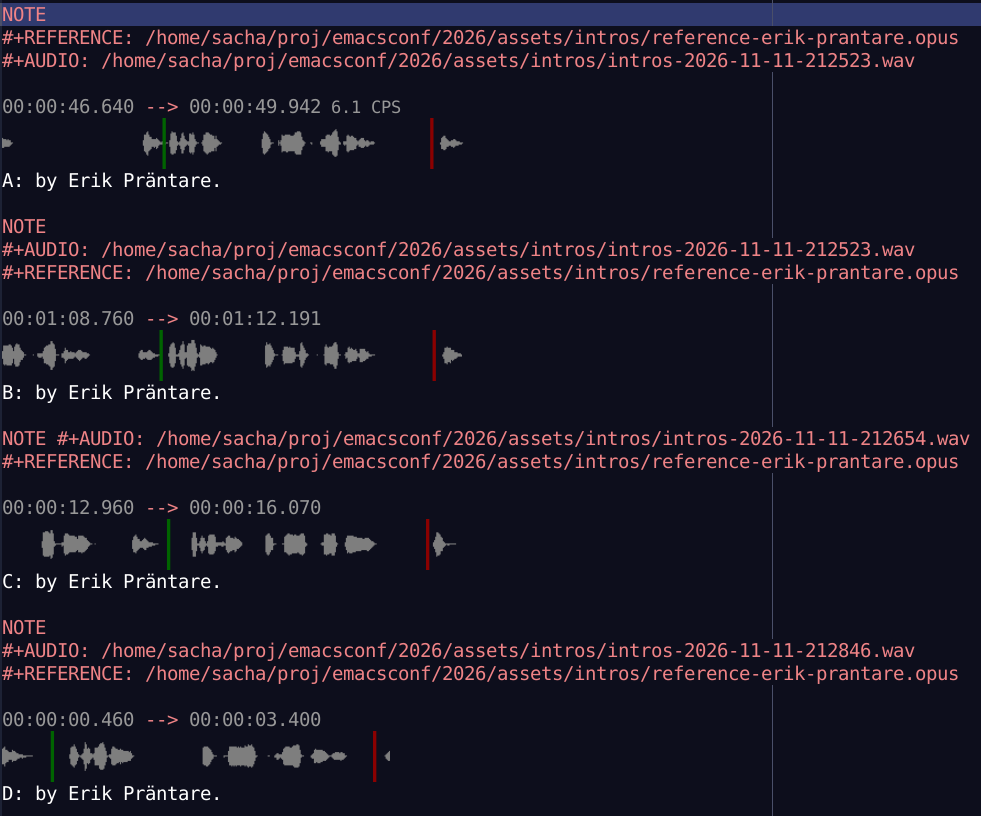
Then I used emacsconf-mail-intro-to-all to send emails to all the speakers with the links to the intros for review. Many speakers confirmed that their pronunciations were fine, and some replied with a recording of their name so that I could use it for reference. I added those in the comments so that I could replay them while recording with R (learn-lang-subed-record-play-current-reference) or learn-lang-subed-record-play-reference-and-current-subtitle. I also copied and pasted the relevant part of the caption file so that I could record different variations with subed-record. It's just text, after all, so it's easy to do all sorts of things the way that you would do them normally in Emacs. For example, here's what it looked like when I was editing the versions for Erik's name:

2026-11-12_14-48-14.png
Figure 2: Screenshot showing reference comments

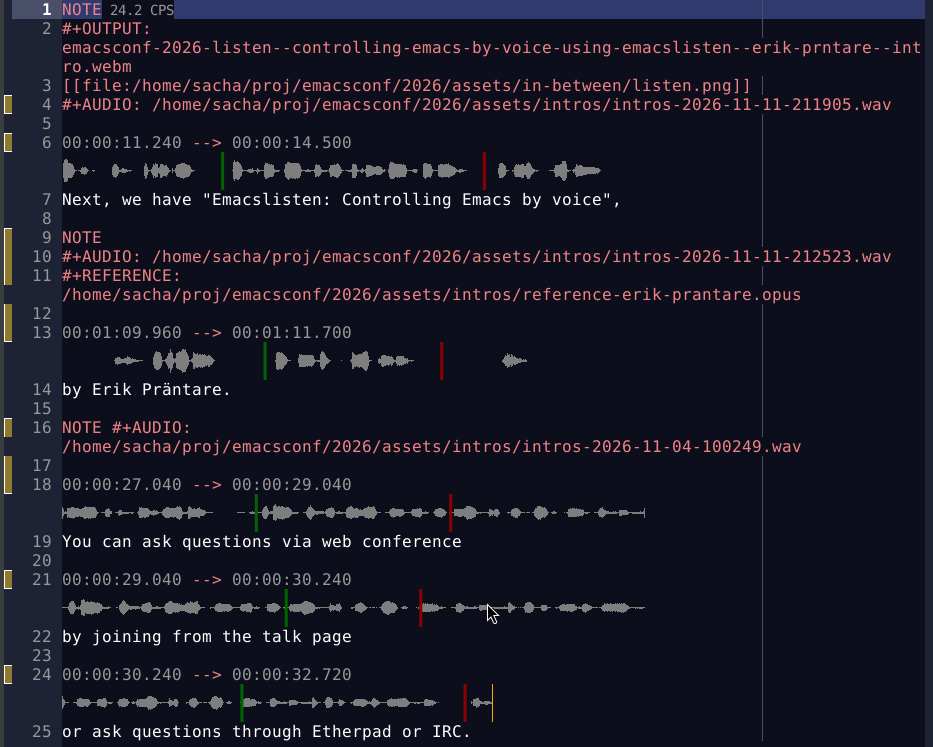
Erik said option B sounds closest. It's not quite perfect, but it's closer than the pronunciation I started with. I might circle back around to this and try again sometime. =) Anyway, to use option B in the final video, I can just delete the cues for the other versions and remove the part where I said option B. Then I can select that part of the subtitles and compile just his video.

2026-11-12_21-14-47.png
Figure 3: After selecting the audio for Erik's intro

This makes it easy to update the intros whenever something changes. For example, if a speaker turns out to be available during the conference for a live Q&A session, I can update the Org entry for their talk (set :Q_AND_A: live), regenerate the intro slide, and re-record the Q&A explanation or even copy-and-paste one from a different intro. They can also change their talk title and that's totally okay. Yay Emacs!

View Org source for this post

2026-11-09 Emacs news

| emacs, emacs-news

: Added EmacsSF this Saturday.

The Emacs Carnival theme for November 2026 is Discovering Emacs features. Thanks to Raymond Zeitler for hosting. Looking forward to reading your thoughts!

There is a very long discussion about Human Emacs and LLM-assisted contributions on emacs-devel. It is a lot. I don't want to throw fuel on the fire. I'm mentioning it because it's a topic that a lot of people care very strongly about, and because there's a subdiscussion about slavery that might ripple out into the wider community. If you do decide to weigh in, please be kind and thoughtful. Thank you!

Links from reddit.com/r/emacs, r/orgmode, r/spacemacs, Mastodon #emacs, Bluesky #emacs, Hacker News, lobste.rs, programming.dev, lemmy.world, lemmy.ml, planet.emacslife.com, YouTube, the Emacs NEWS file, Emacs Calendar, and emacs-devel. Thanks to Andrés Ramírez for emacs-devel links. Do you have an Emacs-related link or announcement? Please e-mail me at sacha@sachachua.com. Thank you!

View Org source for this post

EmacsConf: Thinking about the community panel

| emacs, community, emacsconf

We have a recording session for the EmacsConf 2026 panel on community tomorrow. I want to get my thoughts together so that I can answer concisely, saving the details for this post so that people can dig into it before or after the conversation. So here are some rough notes:

  1. What made you start using Emacs, and what kept you using it?
  2. What took you from using Emacs to actively contributing to the community - participating in forums, writing Elisp, organizing meetups, answering questions?
    • I tend to respond well to specific people's specific needs/requests/suggestions rather than abstract ideas.
      • The main things I do all started out as someone else's suggestion. Aside from my blog, that is; that I do because otherwise I'll forget. But John Wiegley asked me to do Emacs News, so I did. Amin Bandali suggested reviving EmacsConf, so here we are. Tess O'Connor's planet.emacsen.org server went down, so now I run planet.emacslife.com. I don't take everything on, just the things that suit me well, but suggestions are welcome.
      • It's a lot easier for me to help when someone else is concretely involved. For example:
        • scheduling a conversation with someone and making it open to other people to join is easier for me than just talking out loud by myself
        • "have an IRC channel for my livestream" is a bit abstract; it's hard to pay attention to it when it's empty. "Sacha, can we use this channel to discuss the current livestream" works better for me because there is a specific person who's already there.
        • It's hard to make my code more generic, but it's more motivating when someone reaches out in the process of trying to get my code to work for them.
      • Sometimes in the process of putting together Emacs News, I'll come across people's questions on Mastodon, and I will write some Emacs Lisp for their question because I think it's a good idea and I'm curious too.
    • Tinkering keeps me going. Ex: building lots of automations for EmacsConf because I'm curious about what's possible.
      • I'm not a starter, I'm not a finisher, I just like tinkering and making things better.
    • Takeaway: suggest things to me and figure out time so we can get the ball rolling together. Things are more likely to happen if there's another person on the other end of the line. Don't take it personally if I pick something else to focus on instead; there's only so much time at the moment. =)
  3. How does Emacs show up for you in real life - colleagues, meetups, friends? How did those connections form?
    • I'm busy with family stuff and we still keep COVID precautions, so I don't go to tech meetups and conferences like I used to. I prefer connecting with people virtually. I like reading people's blog posts, watching their videos, attending virtual meetups, chatting with people during my livestreams, and organizing this conference. This gives me a sense of other people working in this space.
    • I feel warm and fuzzy about many people in the community. There are a lot of people I appreciate. Positive when I see people helping out and sharing, negative when people are being grumpy.
  4. If you know other software communities, what's one thing Emacs could learn from them?
    • The Neovim community does the YouTube/Twitch thing very well. I want to learn from their community cultivation and production processes. If we have more conversations and videos, maybe that will help people learn by looking over other people's shoulders. If we have more cool demos, that might draw more people in.
    • Python and Debian do really cool things in terms of mentorship, community, and outreach. They're a lot bigger than we are, though. I wonder how we can do those things on a much smaller scale without burning people out.
    • The communities around large language models and AI are also dealing with the Lisp curse (ease of making your own solution means less sharing), so it might be interesting to see what evolves from them. Right now it's a bit of a mess; there's even more cargo-culting there.
  5. What's one concrete thing you wish existed in the Emacs community a year from now?
    • Hah, I don't necessarily want to add to someone else's TODOs. Here's what's on my list:
      • Maybe an OrgModeConf for outside-Emacs collaboration, depending on whether we're at the point of being able to share workflow ideas with other people? More cross-pollination, maybe?
      • I want to get better at connecting with subcommunities so that people can bump into each other. Maybe that looks like checking the mailing lists / chats myself, or maybe someone can blog updates once in a while.
      • I'd like to experiment with office hours and video calls so that people can share their screen if they want help with something. This could be an additional meetup. I might start with speech recognition / speech synthesis, since that's what I'm interested in these days.
      • I also want to work on my clipping/transcription workflow to more easily share videos. This looks like more videos and blog posts.

If you want to reflect on the questions, please feel free to do so and to share your responses with me or on your blog. (You don't have to be one of the panelists. =) )

View Org source for this post

Turning 43; life as a 42-year-old

| review, yearly

Better late than never. Somehow it just seems that life gets busier and busier, doesn't it?

Last year, I wrote:

I wonder what things will be like in a year, in five years, in ten years. I think things are going to be harder, not easier. I want to use this time to store up good memories and prepare for the storm. I want to keep developing relationships, playfulness, and practical life skills. I want to stay flexible and practise acceptance. There will likely be some tough decisions in my near future. It sucks, but other people have made it through before, and we can too.

The storm did come in the form of health challenges for people that I care about, and we did make it through. There were moments when I felt the weight of stress on me, but I took it slowly, dropped things that were not essential, and asked for help. It's not over, of course. There's more to come. But I think we're starting from a pretty solid foundation, and that's going to help.

Back then, I had been thinking about:

  • How can I get better at supporting A+ when she wants help and step back when she wants to try things on her own?
    • I've been taking a step back and letting her manage classwork, homework, attendance, participation, all of those things. This has been working out better for us than otherwise. Sure, there are days when I feel a bit nervous about letting her sleep in so many times in a week. But ultimately, she's going to have to be the one in charge, and it's better to figure out if she needs or wants help while the stakes are low.
  • How can I get better at managing myself so that I can enjoy the time she wants to spend with me and pounce on the opportunities to do my own things when she wants to be independent?
    • When things go smoothly, I now have a couple of hours of focus time during schooldays that I can use to code and write and draw. This makes it easier for me to enjoy spending time with the kiddo when she's out of school, because I know that I can postpone any ideas to the next day.
  • What do I really value, and what am I willing to sacrifice?
    • I'd rather help the kiddo figure out something that works well for her long term, even if it might mean dealing with other people's opinions on parenting decisions.
    • I'd rather prioritize our long-term health, even if it means figuring out different ways to be present when people are going through a hard time.
  • What's in my control? What can I influence? What's outside both?
    • The outside world has gotten even messier, but that's okay, we'll just keep plugging along. I can learn more about connecting with local communities and seeing how to help there too.

This year

This year, it's been satisfying seeing people grow into themselves. The kiddo is ten, as she often likes to remind me. She's figured a lot of things out. She's been enjoying gymnastics and Pokémon. Attending virtual school is still not one of her favorite things to do, but she's proud of her ability to do well. We've been talking a lot more about neurodivergence and figuring out the kinds of things that work for you. We regularly use earbuds to manage sensory overstimulation in noisy environments and lots of hugs to feel warm and cozy. I love seeing her overhearing her negotiate with her teacher for an introvert breakout room when the students are playing Gimkit because her classmates tend to yell in their excitement and she finds it a bit loud.

I started learning French because the kiddo started taking it in school, and that's been working out really well too. I love the exercise of getting my brain to do things, and I've been having a lot of fun tinkering with my tools and processes as well. My daughter and I have gotten to the point of being able to enjoy going through some of the simpler graphic novels for series that we've read so many times in English. I've also been able to go to things like Emacs Paris online, and I had four Emacs Chats in French.

This year, I had a lot of fun hanging out with the kiddo. I think we spent more time together playing together than in previous years because we've found more things that we both enjoy. We had started playing Dungeons and Dragons with her cousins, but even when they got busy, we continued with our own adventures. Now we have all these adventures we've built up around her pet owlbear. I DM for her and I also play a fighter so that someone's around to tank melee attacks. AI has been pretty handy for quickly resolving questions about rules and generating story ideas. In addition to having lots of dice at home, I can can also roll virtual dice on my phone. This lets us tell stories wherever we are, including when we're waiting in line for roller coasters. This summer, we went to Canada's Wonderland a lot. Turns out the kiddo loves coasters and other thrill rides, so that's been a great way to spend time outside.

Blog posts

I wrote fewer blog posts than last year. I want to improve my sharing workflow so that I can share more easily.

Sketches

Time

Category The other year % Last year % Diff % h/wk Diff h/wk
Discretionary - Productive 12.6 16.7 4.1 28.1 7.0
Personal 9.2 12.9 3.7 21.7 6.3
Discretionary - Family 0.3 0.8 0.5 1.3 0.8
Unpaid work 4.2 4.5 0.3 7.5 0.5
Sleep 33.4 32.4 -1.0 54.4 -1.7
Business 2.2 1.1 -1.1 1.9 -1.8
Discretionary - Play 3.0 1.3 -1.7 2.2 -2.9
A+ 35.2 30.3 -4.9 50.9 -8.1

It's almost a straightforward shift from childcare to productive time, which is mostly Emacs, and a little bit more personal care time rather than playing. My evenings and weekends still feel mostly focused on childcare. It's just that I have more weekday time for my own things. I've also been able to wake up earlier for things like sessions with my French tutor or Emacs Chats with other people.

Going forward

I finished my consulting contract lately, so it'll be interesting to see how to manage my finances when I'm living completely off savings and investments. There's a bit more paperwork because I have to go figure out adjusted cost bases, but I think I'll be able to get the hang of it. I don't think it's going to change my time allocation very much, because my consulting was down to about two hours or so a week. But now I don't have to worry about accidentally missing a message or making sure that I can figure out my old code enough to implement a request. It was nice to get to a good solid end. The client was very happy with my work, and I was very happy with how that whole thing turned out.

With my interest in practicing French and getting the hang of talking out loud, I've been playing around with speech recognition a lot more. I'm happy to find that the local speech recognition models have actually gotten pretty good. I've been experimenting a lot with speech recognition and voice commands in Emacs. I'm looking forward to exploring that this year.

I've been sharing more of those experiments through live streams. It's one of those things that it's hard to get a sense of when you're just reading it off a blog post or code. That's been going well too, because I like the kinds of conversations I have and the ideas that people share.

I also like how we've been getting more involved with safe streets advocacy in Toronto. I'd like to see what we can do to help. Even as it feels like the outside world is getting crazier and crazier, I've been lucky enough to meet a lot of people who have their head on straight and who are trying to make things better. I want to help.

We'll see how it goes. We'll see how we grow.

View Org source for this post

2026-11-02 Emacs news

| emacs, emacs-news

Belated happy 50th birthday, Emacs!

In other news, you can now reach Emacs News at https://emacs.news. Enjoy!

Links from reddit.com/r/emacs, r/orgmode, r/spacemacs, Mastodon #emacs, Bluesky #emacs, Hacker News, lobste.rs, programming.dev, lemmy.world, lemmy.ml, planet.emacslife.com, YouTube, the Emacs NEWS file, Emacs Calendar, and emacs-devel. Thanks to Andrés Ramírez for emacs-devel links. Do you have an Emacs-related link or announcement? Please e-mail me at sacha@sachachua.com. Thank you!

View Org source for this post