Update Aug 22 2013: See presentation at the end of this post.
 I built library-book tracking into Quantified Awesome in October 2011, hard-coding the patterns used by the Toronto Public Library system. I regularly hit the 50-book checkout limit and sometimes have to check items out on my husband’s account, so it really helps to have a system that can tell me what’s due and when on all the library cards that we have.
Crunching the numbers
In the 668 days (or 95.5 weeks) between October 1, 2011 and the time I exported my data for number-crunching, we checked out 1,252 items, or an average of 13 items a week. That included 250 movies and 44 other videos (TV series, documentaries, and so on). I’m boggled to find out that I checked out only 8 science fiction books. There were 152 other fiction books, including graphic novels and manga.
… 250 movies borrowed from the library results in saving of $150+ a month assuming we snag DVDs at $15. Not that we would watch 2.6 movies a week if we had to pay for them. In November 2011, I tracked the retail prices and page count of the books I read: $1,075 and 10,671 pages in a month, boggle. I don’t read all of those pages thoroughly, mind you; I tend to skim books looking for just what I need. Still, there’s no denying that the Toronto Public Library saves me a heck of a lot of book and entertainment money.
I figured I’d probably want to take a look at my reading list at some point, so I had programmed the system to record titles and Dewey Decimal System classifications as well. Fiction books and feature movies tend to have generic codes, but nonfiction books show me interesting patterns in my reading habits.
Here are my top categories:
| Dewey Decimal Classification |
Number of items |
| 650 – Management & auxiliary services |
328 |
| 330 – Economics |
82 |
| 150 – Psychology |
59 |
| 740 – Drawing & decorative arts |
45 |
| 800 – Literature, rhetoric & criticism |
38 |
| 000 – Computer science, knowledge & systems |
33 |
| 640 – Home economics & family living |
30 |
| 610 – Medical sciences; Medicine |
22 |
| 300 – Social sciences, sociology & anthropology |
18 |
| 340 – Law |
14 |
Here are my top sub categories:
| Dewey Decimal Classification |
Number of items |
| 658 – General management |
213 |
| 650 – Management & auxiliary services |
92 |
| 332 – Financial economics |
45 |
| 808 – Rhetoric & collections of literature |
37 |
| 741 – Drawing & drawings |
28 |
| 158 – Applied psychology |
24 |
| 153 – Mental processes and intelligence |
22 |
| 641 – Food & drink |
19 |
| 005 – Computer programming, programs & data |
18 |
| 613 – Personal health & safety |
15 |
Here they are, broken down by Dewey decimal group:
| Dewey Decimal Classification |
Number of items |
| 650 – Management & auxiliary services |
328 |
| 658 – General management |
213 |
| 650 – Management & auxiliary services |
92 |
| 657 – Accounting |
9 |
| 659 – Advertising & public relations |
5 |
| 651 – Office services |
4 |
| 652 – Processes of written communication |
3 |
| 653 – Shorthand |
2 |
| 330 – Economics |
82 |
| 332 – Financial economics |
45 |
| 338 – Production |
15 |
| 331 – Labor economics |
10 |
| 330 – Economics |
9 |
| 339 – Macroeconomics & related topics |
2 |
| 333 – Land economics |
1 |
| 150 – Psychology |
59 |
| 158 – Applied psychology |
24 |
| 153 – Mental processes and intelligence |
22 |
| 155 – Differential and developmental psychology |
11 |
| 152 – Perception, movement, emotions, and drives |
1 |
| 150 – Psychology |
1 |
| 740 – Drawing & decorative arts |
45 |
| 741 – Drawing & drawings |
28 |
| 743 – Drawing & drawings by subject |
10 |
| 745 – Decorative arts |
7 |
| 800 – Literature, rhetoric & criticism |
38 |
| 808 – Rhetoric & collections of literature |
37 |
| 809 – Literary history & criticism |
1 |
| 000 – Computer science, knowledge & systems |
33 |
| 005 – Computer programming, programs & data |
18 |
| 006 – Special computer methods |
12 |
| 001 – Knowledge |
2 |
| 003 – Systems |
1 |
| 640 – Home economics & family living |
30 |
| 641 – Food & drink |
19 |
| 646 – Sewing, clothing, personal living |
5 |
| 640 – Home economics & family living |
3 |
| 647 – Management of public households |
1 |
| 644 – Household utilities |
1 |
| 643 – Housing & household equipment |
1 |
| 610 – Medical sciences; Medicine |
22 |
| 613 – Personal health & safety |
15 |
| 616 – Diseases |
4 |
| 612 – Human physiology |
3 |
| 300 – Social sciences, sociology & anthropology |
18 |
| 306 – Culture & institutions |
7 |
| 303 – Social processes |
4 |
| 305 – Social groups |
3 |
| 302 – Social interaction |
3 |
| 304 – Factors affecting social behavior |
1 |
| 340 – Law |
14 |
| 346 – Private law |
8 |
| 343 – Military, tax, trade, industrial law |
4 |
| 349 – Law of specific jurisdictions & areas |
2 |
| 490 – Other languages |
13 |
| 495 – Languages of East & Southeast Asia |
13 |
| 690 – Buildings |
12 |
| 690 – Buildings |
8 |
| 695 – Roof covering |
2 |
| 696 – Utilities |
1 |
| 692 – Auxiliary construction practices |
1 |
| 170 – Ethics (Moral philosophy) |
9 |
| 170 – Ethics (Moral philosophy) |
5 |
| 174 – Occupational ethics |
2 |
| 171 – Ethical systems |
2 |
| 370 – Education |
6 |
| 371 – School management; special education; alternative education |
5 |
| 372 – Elementary education |
1 |
| 720 – Architecture |
5 |
| 729 – Design & decoration |
2 |
| 728 – Residential & related buildings |
2 |
| 720 – Architecture |
1 |
| 810 – American literature in English |
5 |
| 813 – Fiction |
2 |
| 818 – Miscellaneous writings |
1 |
| 819 – Puzzle activities |
1 |
| 814 – Essays |
1 |
| 680 – Manufacture for specific uses |
4 |
| 684 – Furnishings & home workshops |
2 |
| 688 – Other final products & packaging |
1 |
| 686 – Printing & related activities |
1 |
| 770 – Photography & photographs |
4 |
| 775 – Digital photography |
2 |
| 779 – Photographs |
1 |
| 778 – Fields & kinds of photography |
1 |
| 470 – Italic languages; Latin |
4 |
| 478 – Classical Latin usage |
4 |
| 910 – Geography & travel |
4 |
| 915 – Asia |
4 |
| 420 – English & Old English |
3 |
| 422 – English etymology |
2 |
| 428 – Standard English usage |
1 |
| 510 – Mathematics |
3 |
| 519 – Probabilities & applied mathematics |
3 |
| 400 – Language |
3 |
| 401 – Philosophy & theory |
3 |
| 070 – News media, journalism & publishing |
3 |
| 070 – News media, journalism & publishing |
3 |
| 620 – Engineering & Applied operations |
3 |
| 629 – Other branches of engineering |
2 |
| 620 – Engineering & Applied operations |
1 |
| 390 – Customs, etiquette, folklore |
2 |
| 398 – Folklore |
2 |
| 160 – Logic |
2 |
| 160 – Logic |
2 |
| 360 – Social services; association |
2 |
| 362 – Social welfare problems & services |
2 |
| 020 – Library & information sciences |
2 |
| 025 – Library operations |
1 |
| 021 – Library relationships |
1 |
| 750 – Painting & paintings |
2 |
| 759 – Geographical, historical, areas, persons treatment |
1 |
| 751 – Techniques, equipment, forms |
1 |
| 380 – Commerce, communications, transport |
2 |
| 381 – Internal commerce (Domestic trade) |
2 |
| 970 – General history of North America |
2 |
| 977 – General history of North America; North central United States |
1 |
| 974 – General history of North America; Northeastern United States |
1 |
| 700 – Arts |
2 |
| 709 – Historical, areas, persons treatment |
1 |
| 700 – Arts |
1 |
| 190 – Modern Western philosophy |
1 |
| 191 – Modern Western philosophy of the United States and Canada |
1 |
| 030 – Encyclopedias & books of facts |
1 |
| 031 – Encyclopedias in American English |
1 |
| 780 – Music |
1 |
| 786 – Keyboard & other instruments |
1 |
| 290 – Other & comparative religions |
1 |
| 296 – Judaism |
1 |
| 210 – Natural theology |
1 |
| 210 – Natural theology |
1 |
| 520 – Astronomy & allied sciences |
1 |
| 523 – Specific celestial bodies & phenomena |
1 |
| 950 – General history of Asia; Far East |
1 |
| 952 – General history of Asia; Japan |
1 |
| 710 – Civic & landscape art |
1 |
| 712 – Landscape architecture |
1 |
| 630 – Agriculture |
1 |
| 635 – Garden crops (Horticulture) |
1 |
| 500 – Sciences |
1 |
| 501 – Philosophy & theory |
1 |
| Grand Total |
776 |
I read a lot of management, personal finance, and psychology books. I enjoy reading them. I read them at breakfast, over lunch, before bed, on weekend afternoons. I’m not surprised by the proportions, although I’m a little surprised by the number – have I really checked out an average of eight nonfiction books a week? Gotten through more than 300 management-related books? Neat.
Time
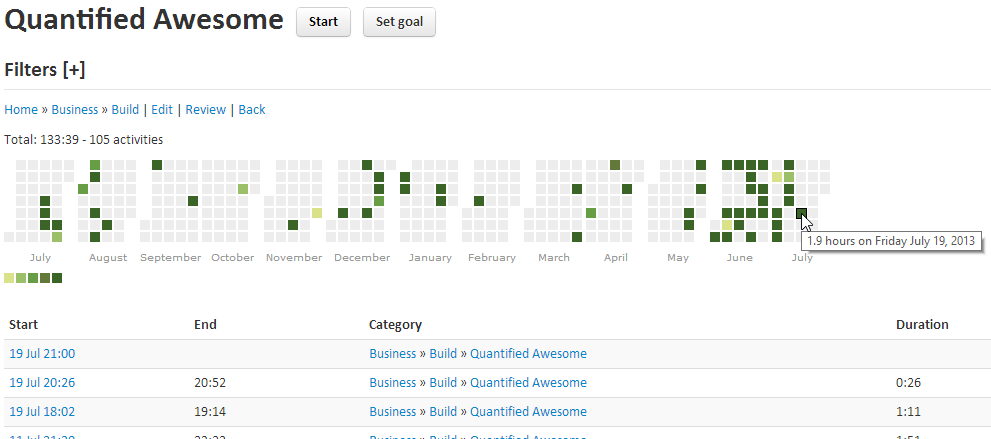
The time data in my current system goes back to November 29, 2011. Excluding the nonfiction books that were returned before then (although still including the books I currently have checked out that I haven’t read yet), there are 727 nonfiction books checked out. Let’s assume I’ve read or skimmed through 80% of those (I’m probably closer to 90%) – that’s ~580 books. I’ve tracked 123.3 hours as “Discretionary – Productive – Nonfiction”. This undercounts the number of hours because I tend to read things over meals and during subway commutes, so let’s double that time to be in the right ballpark for multitasking. That’s a little less than half an hour per book… which is actually quite reasonable, considering I skim through most books in 10-15 minutes each and spend maybe two hours reading selected books in depth (the ones that I take notes on, for example).
This is what my nonfiction reading habit looks like, with the dark boxes indicating when I read more. (This doesn’t take into account reading while doing other things.)

That’s interesting… I read a lot more frequently when I was starting up my business in January/February 2012 (although I wonder what happened in April!). I read more sporadically now. I think it’s because I’m re-figuring-out my strategies for taking notes and applying ideas to my life.
How do I pick books to read?
The library releases lists of new books on the 15th or 16th of every month. I’ve written a small script that extracts the titles, authors, and IDs of the book into a text file that I can review. I delete the lines that I’m not interested in, and my script then requests the books that remain on the list. I monitor the new releases because I don’t want to wait for the usual press
When I ‘m learning about a topic, I tend to check out six or more books related to it. A wide variety of books lets me see different viewpoints, and I can focus on books of better quality.
I occasionally look at Amazon’s recommendations for other ideas, although the books are often not yet available at the library.
Sketchnoting a new release can have high impact, which is another reason why I monitor the new releases. I sometimes reach out to publishers for review copies as well.
The library doesn’t carry everything. I usually add other interesting releases to my Amazon wishlist. I rarely buy books, though, because there’s just such an interesting backlog that I haven’t yet gotten through. I buy books if there are clever illustrations that I’d like to use for ongoing inspiration, or if I want to give the book to a friend, or if it’s an older book that someone has recommended to me and the library doesn’t stock it. Now that I have a business, I usually file those books as business expenses.
So much for quantity. If I’m reading all that, what am I doing with it?
I use books to:
- Learn about different viewpoints and approaches, especially scenarios that I might not anticipate on my own
- Learn how to organize and communicate complex ideas
- Get shortcuts on explaining ideas – for example, I don’t have to explain outsourcing from scratch, because I can point people to the 4-Hour Work Week for starters
Many of the ideas I pick up from books resurface in my blog posts and experiments. Books help me recognize what’s going on in real life, because the authors have already come up with words for them. I also like applying the advice from books – much to learn.
I frequently recommend books to other people. Visual book reviews make that easier. I try to slow down and recognize books that I’ll probably recommend to others so that I can make visual book reviews of them while I have the book. Sometimes I’ll take quick text notes for myself and then use that for reference. If I find myself recommending the book frequently, then I’ll check it out again and make better notes.
I don’t review my book notes much, relying instead on situations to trigger my memories. When I come across something that’s related to a book I’ve read, or I talk to someone who could benefit from a book recommendation, I dig through my visual and text-based notes.
Next steps
“Better” isn’t about reading more books – it’s about being able to apply, organize, and share what I’m learning from those books. I want to learn more about doing good research: identifying a topic to explore, synthesizing insights from multiple sources, and adding personal experiences or ideas. The process might look like this:
- Outline a topic for research
- Search the library catalogue for resources; also check bibliographies, Amazon, and other recommendations
- File properly-cited notes so that I can give credit later on
- Compare and organize ideas from different sources
- Test ideas in small experiments
- Write blog posts, then articles, then e-books
Visual book reviews are another way for me to grow. In addition to making visual book reviews of interesting new releases, I’d like to revisit the books that were a big influence on me in order to make visual reviews of them too.
Yay for Quantified Self and tracking. Onward!
(Also, if you’re curious about tracking your own library use: I can probably extend Quantified Awesome to support other libraries with online interfaces, but you’re going to need to walk me through how your library works.)
Update from August 22, 2013: Here’s a presentation I’m putting together for Quantified Self Toronto.