Feel free to use/share this sketch under the Creative Commons Attribution Licence.
I liked the reminder to organize events based on what you want, tuning in to what you need and what kind of life you want to have. I like learning about Emacs, so EmacsConf is right up my alley, and the fact that I get to tinker with code and processes is actually a large part of the fun. =)
I thought it was interesting that Happy Town is focused on building a
collective of event hosts. Sometimes it's hard to find a venue
(especially for free or low-cost non-commercial events), and it sounds
like they have a few places that are happy to host small events. The
next challenge is knowing that at least one other person is going to
show up. That's one of the nice things about developing a community of
hosts and regular participants who can show up for each other.
The thing Adam said about asset-based community development is also
interesting. Many people pitching in a little bit of money each can
often work out better than relying on one or two big grants or
sponsorships, thanks to more of a sense of shared ownership. I tend to
shy away from soliciting or managing donations. It gets complicated
when transactions come into play, and I like keeping it gift-based. I prefer
to offer whatever I'm comfortable funding by myself, and my attention
is too limited to scale up much even if other people give money.
People giving time, though… That's awesome.
I think I'm not actually looking for that many new things to add to my
life at the moment, social-wise. The kiddo still wants to spend time
with me, so I want to prioritize her since this time is so fleeting. I
do a bit of volunteering, but it tends to either be things I can do
mostly asynchronously, or things that she's also interested in and
that she can contribute to, or low-commitment things that I can do or
not do. I also tend to focus on opportunities to help out rather than
hang out: we've cooked, we've sorted donated stuffed toys, we've
picked up trash, we've delivered groceries and prepared meals.
I find the repetitive scripts and busy-ness of making hot chocolate
for people at protests relaxing, too. ("Would you like dark chocolate,
milk chocolate, or vegan? Half cup or full cup? Marshmallows, candy
canes, both, neither?") I'm glad other people are figuring out what
works well for them and building communities along the way.
Ma fille est aveugle de l'œil gauche à cause d'une microphtalmie. Elle voit bien avec l'autre œil. Mon mari et moi sommes très myopes (lui plus myope que moi) et elle porte déjà des lunettes avec une forte correction, donc il est possible qu'elle devienne aveugle ou que sa vision soit limitée. Quand elle avait 1 ou 2 ans, j'avais demandé à l'ophtalmologue de nous orienter vers l'INCA (Institut national canadien pour les aveugles) pour nous informer sur les signes à surveiller et les ressources disponibles. Quelqu'un nous avait rendu visite pour mesurer sa vision et pour nous offrir un livre d'initiation au braille. Nous n'avions pas besoin d'aide supplémentaire parce que, comme je l'ai dit, elle voit bien ; elle peut faire du vélo, elle peut participer à l'école virtuelle, elle adore lire des livres imprimés. Le livre en braille était sur notre étagère depuis longtemps. Récemment, ma fille l'a découvert, et elle s'est intéressée au braille. Elle m'a demandé plusieurs fois de guider sa main en lisant des caractères aléatoires pour s'entraîner à les lire, et elle m'a demandé d'acheter une tablette et un poinçon pour écrire en braille.
La tablette et le poinçon sont arrivés aujourd'hui. Nous avons donc écrit et lu en alternance des messages avec une liste limitée de lettres. Nous avons commencé par des mots tels que « dog » et « good », puis « good dog, hide » et « bad dog dug food ». Si elle se réveille à temps pour l'école demain, je vais laisser un petit mot en braille dans sa boîte à lunch.
Je veux apprendre le braille depuis longtemps parce que je préfère me préparer à toute éventualité. Et c'est toujours notre philosophie de soutenir la curiosité de notre fille qui nous emmène vers de nouveaux horizons.
We attended the town hall on the topic "How are we going to protect our bike lanes?"
It was wonderful to see hundreds of people thinking about concrete ways that they could help make things better.
I loved seeing all sorts of people there, and even more that our 10-year-old daughter stood up to host a breakout session on a topic she cares about: supplies and repairs during protests.
Here were the general topics for open space conversations and some notes on next steps
(thanks to my husband for extra notes!):
rapid response: shift plan
organizing health care workers to protect our bike lanes: push media attention, union statements, op eds, journals
organizing parents to stand up for bike lanes: For Our Kids, virtual meeting, bike bus?
student organizing/University of Toronto Graduate Students’ Union (UTGSU): posters, stickers, town hall for students
Critical Mass organizing: new ride in May?
non-violent direct action: training on the 29th?
Bike Lanes 101: bring in new people, build people power, small group coffee chats, talk to the 905
engaging business: flip the script, owners, bia, consumers - be visible as cyclists, shopping passport
cycling winter: shovel bike lanes ourselves
connecting to opposition to highway 413
engineering reviews/critiques: will get drawings, make them public
future proofing: build few projects to high standards, accelerate construction, seamless network, push councillors, education, know what good infra is
federal level involvement: disallowance, cut bill 212, organize on ridings basis
website and digital infrastructure: Civic Tech Toronto
storytelling with data: isolate data for Bloor Yonge University lanes, bikeshare counts, ID core audience, biz owners, 905 drivers, common misconceptions, response, more data from city
guerrilla postering: creating a repository of art, setting up a mailing list
supplies and repairs during protest: coordinating supplies at the next protests/events
engaging drivers
organizing non-cyclists allies: open letter
safe complete streets: stop saying bike lanes, say complete streets, beautify, personal stories over stats
how to organize provincially
pressuring the city to not police protests: strategic mtg with councillors, pressure mayor, reduce police budget, testimonials from arrested
I participated in the conversation on organizing parents to stand up
for bike lanes.
We talked about making protests and rallies friendlier for families
and kids through hot chocolate, popsicles, bubbles, stickers, bike
decoration stations, and other activities.
People also exchanged ideas about organizing bike buses to help kids
bike to school, meeting up with other cyclists at bike-friendly cafes
during parental leave, and promoting bike education.
We talked about widening the conversation from a focus on bike lanes
to safety for everyone and connecting to what people care about,
especially through personal stories and concrete life changes.
One of the triggers for the shift towards a stronger cycling culture in the Netherlands was collective outrage over so many child deaths in traffic accidents.
I would like to get to that point without as many individual tragedies.
It's challenging to go to protests and rallies when you have to consider kids in tow.
They get cold and hungry and bored and tired.
They need to go to the bathroom. They need to be safe, especially when there's anger or aggression from people on the road or online. I wonder what can make it easier for families to come.
My husband and I have been going to quite a few of these events
together with our 10-year-old. She likes offering people hot
chocolate, snacks, and hand warmers: little ways to care for people
who care about everyone's safety. I want to connect with other people
so that we can figure out together how to make it easier for families
to get involved. I am totally willing to start with hot chocolate and stickers. =)
I was surprised when our normally quite reserved 10-year-old suggested this open space breakout session herself, standing up in
front of hundreds of people to invite them to a conversation about how
to support protests through supplies and bike repairs. When she talked to the coordinator, she opted for a small space for about 5 people, but we ended up with about 10. She reported the results back to the main audience herself, too.
It's surprising how little things can go a long way to helping people
feel more supported and taken care of. Our experience started by going
to protests and offering people water refills, because it's important
to stay hydrated. Most people have their own water bottles, but they
might run out over the course of a few hours. We have cargo bikes, so
my husband brings this huge container of water and refills people's
bottles. As the weather got colder, we shifted to bringing warm water
too. We're used to making hot chocolate for a crowd because it's a good
way to keep kids warm during an outdoor play date. It's actually
pretty delightful to see even adults light up when you offer them
marshmallows with their cocoa. My husband's also been bringing bike
repair tools, since quite a few people had to deal with flat tires
from debris in contested bike lanes. Other people have even set up
bike stands for check-ups and repairs. Other people have brought hand
warmers and snacks. They pitched in with a variety of masks when the
machines were grinding up the road surface. Little things help.
Sometimes having a list of ideas makes it easier for people to find one or two things they can contribute.
We brainstormed a lot of little things that could help at these events:
table with snacks & info
warmth, water, and food
hot cocoa
hand warmers
popsicles in summer
water: water bottles, refills, hot water
pizza, samosas, etc.
tools
nametags? totally optional
signs, flyers, sign-making station
masks, PPE, first aid
bike repairs: tubes, tools → reach out to bike shops
info
info, contact, sign up
zines
sign-ups to coordinate with Bike Lane Watch?
nearby support sites: where to find bathrooms, nearby bike-friendly businesses to recommend
fun
kid activities, games, fidgets
stickers, sticker trading
other ideas
music
candles
someone to lock up and retrieve a bike if people get arrested
glow sticks, lights, batteries, chargers - Green P: power?
introvert corner
camp chairs, mats, tables
ways to reduce packaging, trash
moral support
$ funds
individuals sharing
tip jar?
that GoFundMe?
It might be nice to figure out how we can coordinate with other people who are thinking of bringing things or ordering things so that
for example, if we're picking up pizza, we don't end up with too much pizza. Maybe the Telegram chat?
Sometimes the protest is on a sidewalk where there's not a lot of space to set up a table or cargo bikes.
It might be a good idea to identify beforehand a park or a side street
where we can set up some more support,
so that people can go there to take a break before they go back into the fray.
For example, when the protests were at Islington,
we stayed at Tom Riley Park, and people came by to refuel as needed.
Is there funding? Quite a few people have offered, although it feels a little complicated.
There has been some kind of fundraiser, but we haven't coordinated anything with them.
People have also offered donations or suggested having a tip jar.
For us, I think we're more comfortable just sharing what we can share as a gift (and avoiding liability! =) ).
I love how other people have, on their own initiative, brought samosas and naan bread and pizza and sesame crisps and Timbits. More potluck than catering.
People suggested putting together some pre-packed boxes so that
they're easy to grab and go as part of a rapid response to the
anticipated bike lane removals next spring. Maybe that's like how we
keep a large bag with cups, marshmallows, stir sticks, and hot
chocolate mix, so that could be a starting point.
I went to An Evening with Valérie Plante to learn about her experience
in prioritizing the environment during her two terms as the mayor of
Montréal. It was interesting to hear about the sponge parks that they
built in order to absorb excess rainwater, designing pedestrian streets for beauty and comfort, the importance of connecting with
public transit, and how they built an express bike network as
part of improving safety for everyone, including the data they
collected in order to make the case.
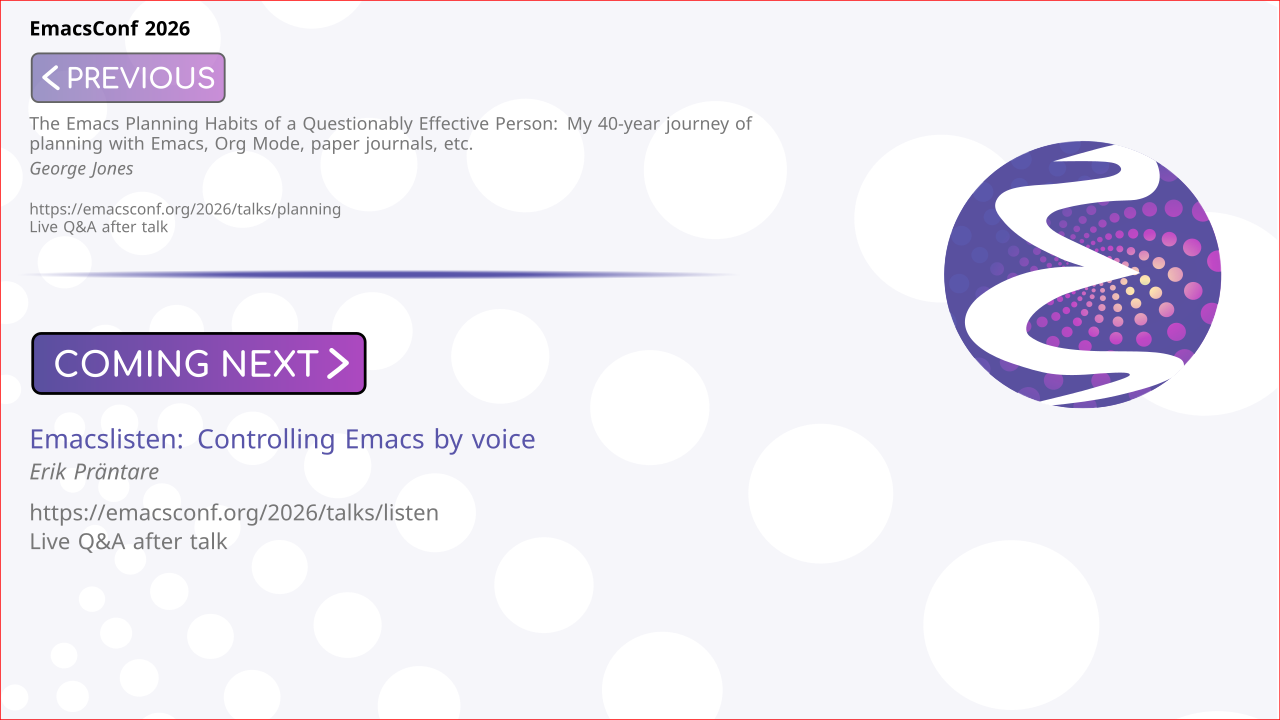
I record brief introductions for all the EmacsConf talks so that they can be played automatically. That way, hosts don't have to worry about pronunciations on air, and there's one less changeover that might introduce technical issues. We can cut to the next talk a bit abruptly because everything runs off a crontab-powered schedule to keep things running on time on multiple tracks, so it helps to have a little transition between Q&A and the next talk. It's also nice having some kind of pronunciation reference so that when people discuss the talks or even just think about them with their internal monologues, they might have a better sense of how to say the speakers' names. We ask speakers to say their names at the beginning of their presentation, but people don't often include their last names, so the intro gets that consistently. The intro videos are available on the talk pages after the conference, and I've occasionally used them to remember how someone's name is pronounced.
Here's an example intro from EmacsConf 2025:
Here's my process for preparing those intros with Emacs.
First, I create all the intro slides with LaTeX and TikZ using the function emacsconf-stream-generate-in-between-pages from emacsconf-stream.el. This year, the template I'm using is _template.tex and the background image is _template_bg.pdf.
I used to use an SVG and just replace the elements within it (template.svg, emacsconf-stream-generate-in-between-page-svg). This year, some of the talk titles are very long and SVG doesn't have widespread support for wrapping.
LaTeX handles wrapping and positioning beautifully. This even allows me to have ligatures like the "ff" in Jeff Trull's name.
I noticed those ligatures disappeared when I used Inkscape to convert to PNG, so I needed this command instead:
inkscape --pdf-poppler --export-type=png -w 1280 -h 720 --export-background-opacity=0 --export-text-to-path
This is the function that generates the individual intro slide:
emacsconf-stream-generate-in-between-page: Use LaTeX to generate the intro slide for TALK based on assets/in-between/_template.tex.
Once I had the intro slides, I prepared my script. I called emacsconf-subed-intro-subtitles from emacsconf-subed.el to create a VTT captions file that starts like this:
WEBVTT


NOTE
#+OUTPUT: emacsconf-2026-sat-open--saturday-opening-remarks--sacha-chua--intro.webm
[[file:/home/sacha/proj/emacsconf/2026/assets/in-between/sat-open.png]]

00:00:00.000 --> 00:00:00.000
Next, we have "Saturday opening remarks",
by Sacha Chua.
You can ask questions via Etherpad.

NOTE
#+OUTPUT: emacsconf-2026-planning--the-emacs-planning-habits-of-a-questionably-effective-person-my-40year-journey-of-planning-with-emacs-org-mode-paper-journals-etc--george-jones--intro.webm
[[file:/home/sacha/proj/emacsconf/2026/assets/in-between/planning.png]]

00:00:00.000 --> 00:00:00.000
Next, we have "The Emacs Planning Habits of a Questionably Effective Person: My 40-year journey of planning with Emacs, Org Mode, paper journals, etc.",
by George Jones.
You can ask questions via web conference by joining from the talk page
or ask questions through Etherpad or IRC.
The text is based on the Org entry properties for each talk in our conf.org file.
It used subed-record directives to define the output files and the visuals.
Then I used subed-record to start recording each segment. I pressed <left> (subed-record-retry) to re-record a segment as many times as I needed to. This adds or updates an #+AUDIO directive that points to the current recording and it also updates the timestamps. When I was satisfied, I pressed <right> (subed-record-accept-segment) to update the ending timestamp and move on to the next segment to record. Whenever I needed to take a break from recording, I used RET (subed-record-accept-and-stop) to accept the last segment and stop.
After recording, I used subed-waveform-show-all to see the waveforms for each segment. I left- and right-clicked on the waveforms to refine the start and end timestamp, getting rid of the sound from the keyboard shortcuts, and I used subed-split-subtitle to split each long cue into the proper lines for the subtitles.
Here's the livestream where I worked on some of the intros.
After editing the audio this way, I used subed-record-compile-video (C-c C-c after subed-record-set-up) to create all the videos by using compile-media and FFmpeg. I could also regenerate just one or two videos by selecting the region and then using the same function..
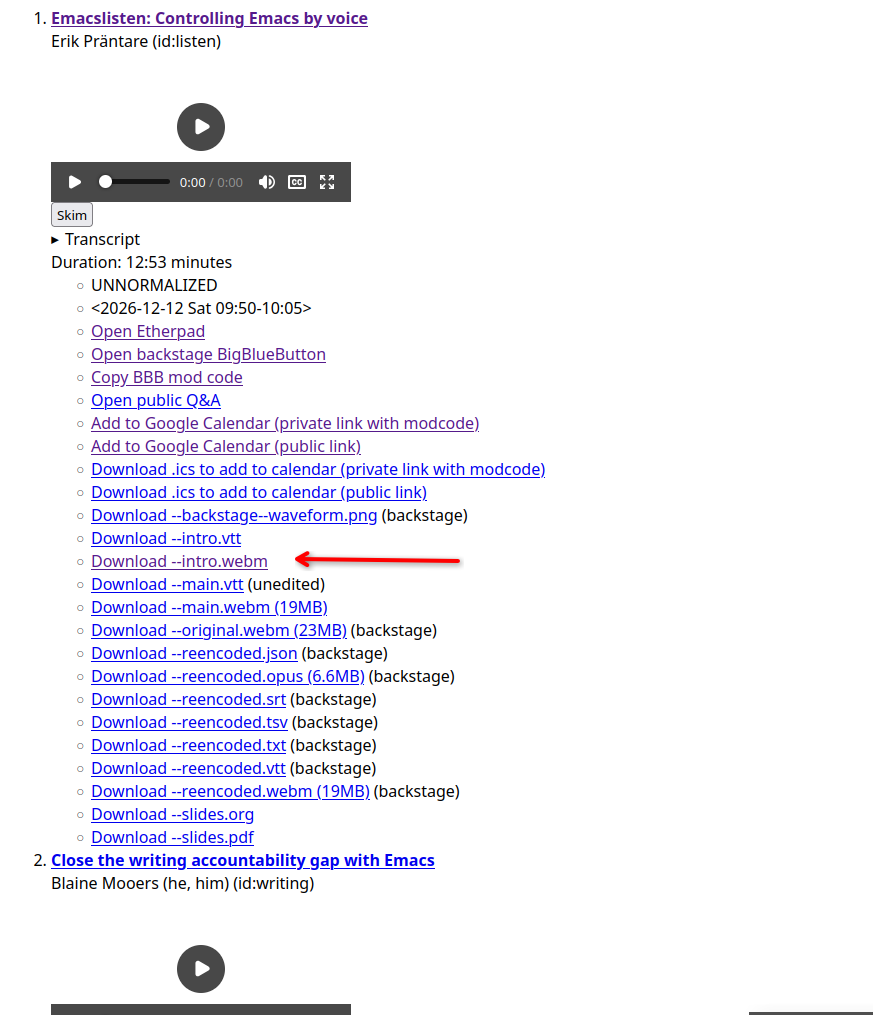
Once the videos finished, I uploaded them to our password-protected backstage area, and emacsconf-publish-backstage-index added them to the page.
Figure 1: Backstage links to intro
Then I used emacsconf-mail-intro-to-all to send emails to all the
speakers with the links to the intros for review. Many speakers
confirmed that their pronunciations were fine, and some replied with a
recording of their name so that I could use it for reference. I added
those in the comments so that I could replay them while recording with
R (learn-lang-subed-record-play-current-reference) or
learn-lang-subed-record-play-reference-and-current-subtitle. I also
copied and pasted the relevant part of the caption file so that I
could record different variations with subed-record. It's just text,
after all, so it's easy to do all sorts of things the way that you
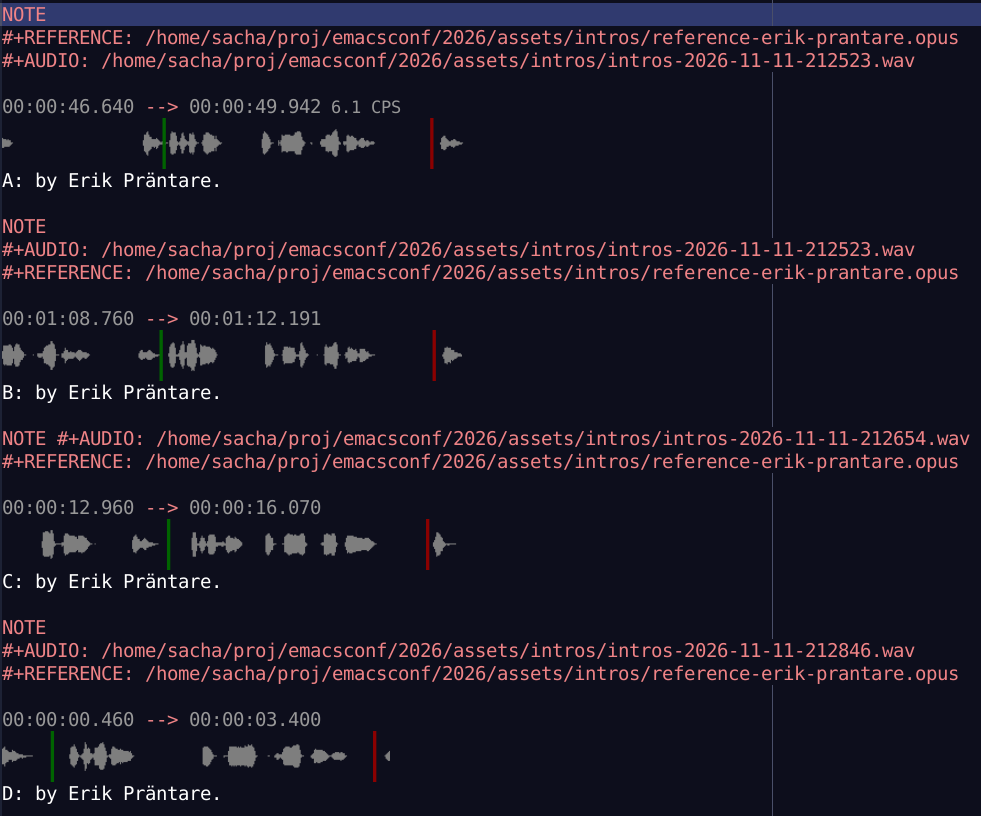
would do them normally in Emacs. For example, here's what it looked
like when I was editing the versions for Erik's name:
Figure 2: Screenshot showing reference comments
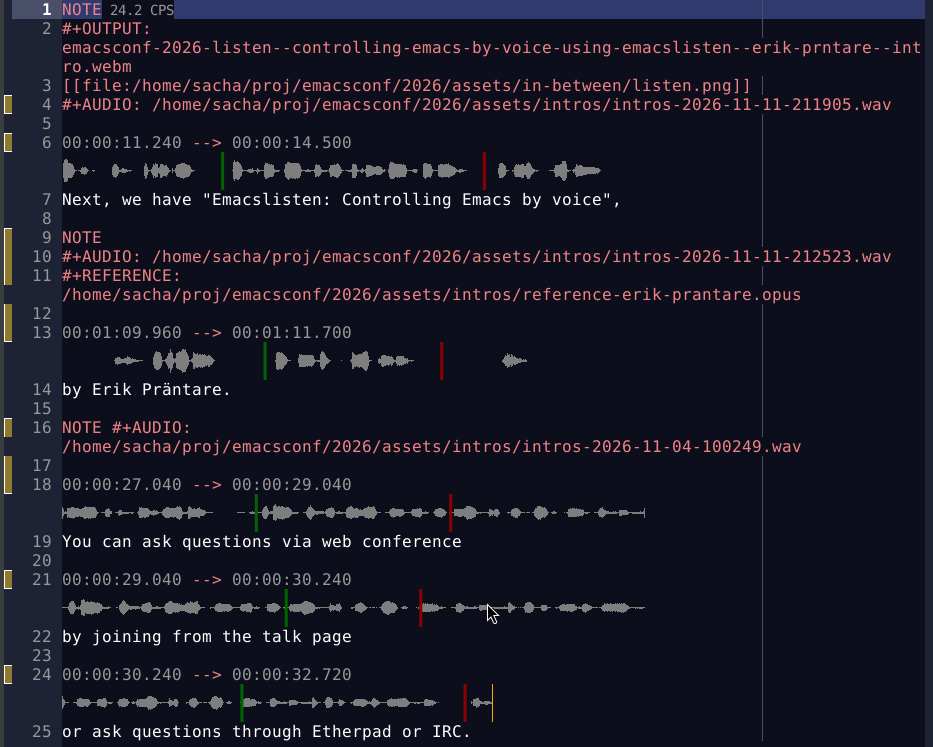
Erik said option B sounds closest. It's not quite perfect, but it's closer than the pronunciation I started with. I might circle back around to this and try again sometime. =) Anyway, to use option B in the final video, I can just delete the cues for the other versions and remove the part where I said option B. Then I can select that part of the subtitles and compile just his video.
Figure 3: After selecting the audio for Erik's intro
This makes it easy to update the intros whenever something changes. For example, if a speaker turns out to be available during the conference for a live Q&A session, I can update the Org entry for their talk (set :Q_AND_A: live), regenerate the intro slide, and re-record the Q&A explanation or even copy-and-paste one from a different intro. They can also change their talk title and that's totally okay. Yay Emacs!
The Emacs Carnival theme for November 2026 is Discovering Emacs features. Thanks to Raymond Zeitler for hosting. Looking forward to reading your thoughts!
There is a very long discussion about Human Emacs and LLM-assisted
contributions on emacs-devel. It is a lot. I don't want to throw fuel
on the fire. I'm mentioning it because it's a topic that a lot of
people care very strongly about, and because there's a subdiscussion
about slavery that might ripple out into the wider community.
If you do decide to weigh in, please be kind and thoughtful. Thank
you!